Showing posts with label KDHS. Show all posts

Sunday, 7 September 2014

The last of Clare...

Loop head continued....
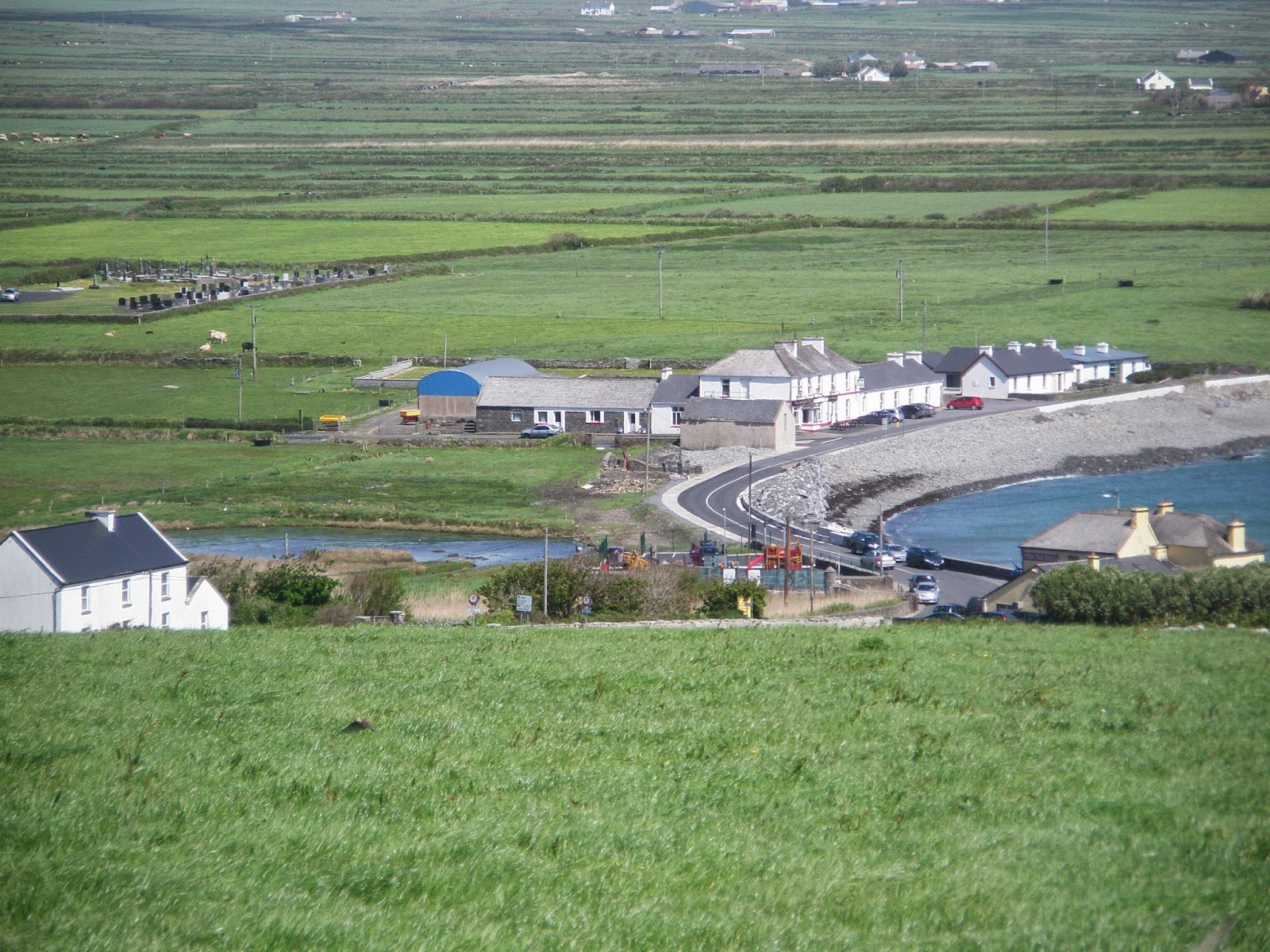
After such a beautiful walk with Laura of The Long Way Round Walking Company, it was time for some refreshment.  Back in Kilbaha, I stopped at the Lighthouse Inn for a bowl of delicious chowder.  The Lighthouse Inn is the pub which was originally run by Susan Pilkington Haier, my 2x great-aunt, back in the 1860's and remained in the Haier family until recent years. I hadn't visited it before, but it was one of the things I wanted to do.  Due to its location right on the foreshore of Kilbaha Bay, the facade of the building had sustained some damage during the storms of the past winter.  Repairs were in progress, both to the Inn and the surrounding areas. 

In the pub, I happened to run into Pip, who had called in to speak to the owner.  Good to see him again, as I hadn't expected to do so.  Pip told me that another mutual cousin had just arrived in Kilbaha from England for a short stay at their family cottage.  So off I went to introduce myself to Veronica, another 4th cousin on the Keane side.  Good to make her acquaintance as well, and exchange email addresses for future reference.


I then went for a short walk around the Kiltrellig end (eastern side) of Kilbaha Bay, visited the memorial to the Grave of the Yellow Men, which was a new addition since my last visit 7 years previously.  The story of the Yellow Men is one of those recorded in our family records, being memorialised in a poem written by Amy Griffin.


The Grave of the Yellow Men

None knew from whither those drowned men came,
Swept in by the foaming tide.
So a grave was dug without a name,
Where they slumber side by side.

Their deeds are not spoken above the clay,
They perished we know not when.
Only a green mound marks today,
The Grave of the Yellow Men.

Even the wild wind sings their dirge,
While the sea birds in echo cry.
And eternally wet by the briny surge,
Is the spot where the strangers lie.

Benefiting for those whose lives are dark,
And whose death was full of pain,
But never recording stone doth mark,
The Grave of the Yellow Men.

Fond wives may have wept through the dreary night,
For the husbands they loved so well,
And at first faint dawn of welcome light,
Arisen, their beads to tell.

To hear the babes as the brightly wake,
Has father come home again?
Oh, hearts may have longed they might only break,
On the Grave of the Yellow Men.

We know they died on the raging deep,
But they lived we know not how.
Well their secret those slumberers keep,
None will ever tell it now.

But we know that the name of each lost one there,
Has been graved by his Maker’s pen.
Nor will He at last have forgotten where
To seek for The Yellow Men.

by Amy Griffin (1855-1910)

From here, I drove out to Ross and had a wander around the rocks there before driving along the coast road to Kilkee and back to Kilrush where I had hoped to catch up with Colin Keane again to see some old family papers he had brought down.  Unfortunately, Colin had decided to go out to Kilbaha for a drive, so we probably passed on the road.

the beach at Ross

I did eventually catch up with Colin over dinner in Crotty's pub, with Paddy Waldron & Kay Clancy.
After keeping myself busy all day so that I wouldn't think about it, it was finally time for my presentation that evening to Kilrush & District Historical Society.  KDHS meets once a month, with a guest speaker on a topic of interest, and Paddy Waldron has always included me on the invitation list each month via Facebook.  Earlier in the year, when I had yet again declined the invitation (Kilrush being a bit far from Melbourne to allow it), I added the comment that I would definitely be there for the May meeting.  Back came the reply from Paddy asking if I would like to be the presenter for that meeting!  After a bit of consideration I agreed, although by the time this evening had come around I was wondering why I did!  I had put together a powerpoint presentation which included some of the references and photos from our family collection, and traced the history of our branch of Pilkingtons (and Griffins) from their earliest records in Clare up to their settlement in South Gippsland.  There is a quite indistinct recording of the presentation here - apparently I needed to inhale the microphone as I spoke.  There was a good turnout for the presentation, and it seemed to be well received, although I did wonder why anyone else would be interested in our family! 


I am so sorry that I wasn't able to have a couple of days in Clare following the presentation.  In hindsight it was a big mistake, although doing so would have meant I wouldn't have had the time with Tom & Sally in London before coming home.  There were several people present who I would have very much liked to follow up with on potential family connections.  In particular, a man named ..... wait for it ..... Tom Pilkington, who lives in Ennis, and who is almost certainly a distant cousin of mine.  Tom owns land at Gortmore which has been in his family for generations.  Gortmore is an adjoining townland to Cragleigh.  In the course of my research, I have found several similarities and parallels between his family and mine, which I would very much have liked to explore further with him.

Sadly, this evening was time to say goodbye to my Clare friends - Larry, Paddy, Kay in particular, but also everyone else who had made me so welcome during my visit.  We retired back to Crotty's for a drink to unwind (well, for me to unwind), and then it was time to re-pack the bags, and toss some unnecessaries to meet to weight requirement for the flight to London.

Monday, 1 September 2014

Kilrush

Monday 26th May
Today I had tentatively booked a tour with Dolphin Watch Carrigaholt.  Waiting for a call from them to confirm whether the trip would go ahead.  The weather was fine, so I was optimistic, but unfortunately received a text in the morning saying they were not going out that day.  On the off-chance, I rang Dolphin Discovery, Kilrush, to see if they may be going out.  The lady I spoke to said they hadn't been out in 3 weeks, due to unsuitable weather, but that today may be ok - she would check and confirm.  A little later, and I was booked for an afternoon trip.

I went for a walk around town to orientate myself, and to check out the location of the Teach Ceoil, the former St. Senan's Church of Ireland which has now been restored for use as a community centre.  It is located in the Kilrush Old Church of Ireland Cemetery, and is the venue for my talk to Kilrush & District Historical Society the next evening.


Site of soup kitchen from Famine times, in the churchyard.
The plaque on the left is a memorial to the soup kitchen
The stone monument is to all those, named & un-named, buried within the grounds.


The Old Cemetery is located in the old Church of Ireland churchyard, but burials there are not confined to those of the Protestant faith. It is currently undergoing a restoration project by a dedicated group of volunteers, and as I wandered down the path I saw a group hard at work with line-trimmers and mowers.  Among them were my "Facebook friends" Kay Clancy & Paul O'Brien, and Michael O'Connell who I had met when I did the walk at Carrigaholt on the first day of my trip.

Kay showed me around the Cemetery, including a Pilkington headstone connected with my family.

Erected by Francis Pelkington, Gower,
in memory of his beloved wife
Elizabeth Pelkington alias Walshe
who died Jan 5th 1893 aged 55 years
R.I.P.
Francis Pilkington (1823-1896) was a son of Richard Pilkington & Maria Blood, and a nephew of Thomas Pilkington of Cragleigh.  Francis (Frank) and Elizabeth married quite late in true Pilkington form, and didn't have any children.  It is very likely that Frank is also buried in this plot, but no-one ever arranged the addition of an inscription.

Feeling slightly overwhelmed by the enormity of the task in front of them, I left the workers hard at it.  They have been trying for some time now to obtain funding and support for an ongoing program of maintenance to minimise further degradation of this important historical location.  Just after my visit, some funding became available from the late Kilrush Town Council, which was put to good use clearing blocked drains which had caused the graveyard to flood.

So, off to the Kilrush Marina for my dolphin-watching expedition.  While dolphins are always fabulous to watch, my main interest in doing this was to see the coastline from the water.  Just lucky for me, then, that the skipper announced he was taking the boat in a westerly direction rather than their more usual easterly one.  This took us out of the harbour, past Scattery Island then down-river to the level of Carrigaholt, where the castle was easily visible on the shore. 

Kilrush Harbour is of interest - the lock gates operating to keep the harbour full of water, and provide safe anchorage at the marina.  Prior to the construction of the lock in about 1990, the Kilrush Creek area would have consisted of extensive mud flats and only been navigable at high tide.

Kilrush Creek Lock

Once through the lock, we passed container ships and storage tankers moored, waiting for clearance to go up-river.  After a little time, we did come across some dolphins, and enjoyed their antics.  Trying to photograph them was a challenge which I gave up on very soon, and settled for watching them as they frolicked around the boat. 

The return trip took us closer to Scattery Island, (Inis Cathaigh in Gaelic), providing a tantalising glimpse of the history contained there.

Scattery Island

Scattery was originally settled as a monastic colony in the 6th century, and in the last few centuries has played a role in the navigation of the Shannon, being home to generations of river pilots.  At one time it formed part of the Keane estate, and features in Charlotte Keane's 19th century diary, where she writes fondly about boat trips to the island and its inhabitants.

Returned to Kilrush with time for a coffee and then a quick change before the drive to Ennis to catch up with Larry Brennan for my next adventure!

The waterfront at Cappagh, on the way back into Kilrush


Tuesday, 12 August 2014

County Clare - Day 6 & 7: Kilbaha

Saturday 10th May
Woke up very snug in my bed this morning and decided to stay put for a while.  The weather outside was atrocious, rain and blowing a gale.  To say nothing of COLD!!!  Goodbye to any plans for today - I had hoped to visit the lighthouse, but no point in this weather.

Up later, and a quick trip out to the car (brrrr!) to bring in my books and laptop.  I set myself up on the dining room table in front of the heater and spent a lovely day working on family history and doing the finishing touches to my presentation for Kilrush & District Historical Society.  What better place to write about family history than in this place which has played such a part in it?

The little wood heater took the chill out of the air, but by late afternoon it was cooling off and I found a single bar radiator which I set up near my feet.  What I would have given for my nice warm slippers!  Pip and Karen arrived in the evening and we spent a couple of hours over a meal and a chat.

Sunday 11th May
Quite sunny this morning for a change, but still cool and windy.  The sun porch at Kilbaha was a great spot to enjoy breakfast and a morning cup of tea.

Loop Head Lighthouse


Up to the Loop Head Lighthouse after breakfast - clear enough for a spectacular view right across the Shannon to the Kerry mountains.  Did the lighthouse tour, and had a quick walk around the perimeter before returning to Kilbaha.  I stopped by the Kiltrellig graveyard, just to get the feel.  Mary Anna(Pilkington) Griffin died in 1887, and her son Bob Griffin who died at Kiltrellig in 1904 are both buried either there in the graveyard, or just over the fence in the adjacent Kiltrellig land.  Family diaries confirm their burials, but there is nothing there to mark exactly where.  The cemetery backs onto Kiltrellig so it provided a view over what would have been the home paddocks and a good idea of what the outlook from Kiltrellig Lodge over the Shannon estuary would have been like.  Kiltrellig Lodge was the summer residence of the Pilkington family, built by Thomas Pilkington in  1834.  It became the permanent family home for the unmarried Pilkington siblings after the death of their parents in 1884, and remained the family home until the death of the last of my grandfathers siblings, Annie Pilkington, in 1961.


Kiltrellig Lodge c1950

 The house was in a state of disrepair at the time of Annie's death.  The story goes that as the house became more and more dilapidated, she would just close it off room by room until at the end she was living in just 2 habitable rooms.  It was eventually demolished.

I then met up with Pip and Karen again, and Pip took me for a walk around the cliff tops, past the ruins of Doondahlin, to the Turret and the Rock pool.  The scenery really is spectacular.
 
Cliff-top view

The Rock Pool


The Turret - built as a smoking house for the men of Doondahlin

After our walk, we met up with Seamus and Ailish Connolly, friends of Pip's who live with their young family just a short way up the road from Kilbaha cottage. Seamus knew all about Kiltrellig and the Pilkington's, mentioned Miss Annie and Miss Edie, even though both they and the house would have been long gone before he was even born!  Enjoyed a cup of tea at their house, and heard about Ailish's plans to open a gallery with a friend.  This is now up and running as Kilbaha Gallery & Crafts, which also incorporates a heritage centre named for a local identity, Henry Blake.

It was difficult to tear myself away from their hospitality, but the drive to Dublin wasn't going to get any shorter, so eventually I made my goodbyes and left.


Kilbaha & Kiltrellig
Kilbaha cottage at left.  The two single storey buildings on the right are the Kiltrellig cottages and are still owned by family connections.