Showing posts with label Kilrush. Show all posts

Monday, 3 July 2017

Transported for 10 years…

The subject of this post is Richard Pilkington, born County Clare Ireland about 1832, the son of William Pilkington, a labourer.  He’s not a confirmed relation to my family, but given the name and location, there is a fair chance of a connection somewhere.  I was prompted to explore Richard’s story while studying a unit on Convict Ancestors with University of Tasmania.

County Clare Ireland in 1850 was still in the grip of an Gorta Mór, the Great Famine. The Kilrush Poor Law Union was one of the hardest hit areas, not only dealing with the effects of the potato blight, but also the mass evictions carried out by landlords and their agents. Some of the worst devastation was instigated by Marcus Keane, known as the Exterminator General of Clare, who happened to be the brother of my great-great-grandmother Anne Keane.  I've written about Anne in a previous post.

In February 1850, at the close of another cold wet winter, people were still being found dead from starvation and exposure. Whole villages lay deserted; their former occupants either dead or emigrated. The detailed reports of Kilrush Union Poor Law Inspector Captain Arthur Kennedy, who was responsible for the relief of the poor and destitute, reveal the suffering he regularly witnessed. Coincidently, Kennedy was to become Governor of Western Australia in 1854.


Not surprising then that people resorted to whatever means they could to survive. Livestock theft was a common occurrence, and the reason 18 year old Richard Pilkington was transported for 10 years.  On the night of February 25th 1850, eight sheep were stolen from the property of Thomas Browne at Cahermurphy.  At the Assizes in Ennis in July, Richard and five other men were convicted of the crime and sentenced to transportation.  We can only guess at their motivation. Perhaps they wanted food for their families, or maybe were hoping to profit from selling the meat at the nearby markets, where mutton was selling for 5 ¼ pence per pound.  Regardless of the reason, Thomas Browne would have seemed like a soft target. He was a well-off linen merchant from Limerick who farmed several parcels of land throughout West Clare.


Clare Journal & Ennis Advertiser 4 July 1850 page 2.

The long journey to Western Australia began in Ennis jail, described in 1845 as “a thoroughly commodious and well-conducted establishment” which had recently been extended.  Four months later, Richard and two of his co-accused were among a group of 20 prisoners transferred to Spike Island Prison in Cork harbour.  Originally built as a military fortress, Spike Island had been used as a convict depot from 1847 and by the time Richard arrived housed over 2300 prisoners.   Conditions in the prison were not ideal and many of the prisoners were unwell and debilitated as a result of the famine.


Clare Journal & Ennis Advertiser 18 November 1850 page 1.

Richard’s stay at Spike Island was of unknown duration. Although the convict ship Robert Small sailed from Spike Island for Swan River with two of Richard’s partners in crime aboard, Richard must at some point have been transferred to Dublin. His convict records in Western Australia reveal he came from Dublin’s Mountjoy Prison, where his conduct was recorded as “good”, although he doesn’t appear in the Irish Prison Records which include Mountjoy.

Built as a model prison based on the separation theory, Mountjoy was completed in 1850 and provided single cells for 450 inmates.  During his time there, Richard would have been kept completely separated from his fellow inmates, in the belief that it would promote “moral and religious improvement”. In fact, the practice was associated with significant deterioration in the mental health of the prisoners.  What a contrast it must have been for Richard to go from the isolation of Mountjoy to the crowded confines of the convict ship Phoebe Dunbar.


Sketch of the Phoebe Dunbar,
Source: R.D.Shardlow, Mitchell Families Online accessed 16 June 2017.
https://mfo.me.uk/showfolio.php?mediaID=2263

The Phoebe Dunbar sailed from Kingstown (Dublin) on the evening of June 3rd 1853, carrying 295 male convicts, and 93 others - pensioner guards and their families.  After a voyage of 89 days, she arrived in Fremantle on 30th August.  Sixteen lives were lost on the voyage, nine of them convicts, with three more dying soon after landing. Disease had been rife on board, with many people suffering from scurvy.  Although sailing a month before the Phoebe Dunbar, the Robert Small had been delayed in transit and had arrived only a few days before. The settlement was unprepared for the influx of almost 600 convicts, many of whom were unwell. Consequently, the convicts remained on board Phoebe Dunbar for three weeks while temporary accommodation was built.


The Perth Gazette & Independent Journal of Politics & News
Friday 2 September 1853 page 2

So began life in Australia for convict number 2449, Richard Pilkington. Described on arrival as being aged 22 and single, he was 5 feet 4 ½ inches tall, of middling stout build with no distinguishing marks. He had black hair, hazel eyes and an oval face with sallow complexion.  He was Roman Catholic and could read but not write.

Richard was assigned to public works in the quarries where constant exposure to dust and grit resulted in severe ophthalmia.  He had several admissions to hospital in 1854-55; the descriptions provided of his eyes leave no doubt that his sight must have been impaired.  The treatments recorded appear to be the standard recommendations of the period, and included green shade to reduce light sensitivity, application of leeches to the temples, and use of various preparations containing mercury, silver, potassium and opium.  Diet was a part of the treatment, and consisted of tea, gruel or broth, designed to keep the digestive tract empty. Richard’s notes show additional foods were introduced as his recovery progressed.

Richard’s progress through the penal system was uneventful, his conduct ranging from “good” to “excellent” when he obtained his ticket of leave on 7th September 1854.  He spent time at Port Gregory and Freshwater Bay convict depots, but no further record of location is available after his discharge from hospital on 19th July 1855.  As a ticket of leave holder, he was able to seek employment from free settlers. He received his conditional pardon on 3rd October 1859.

The next record of Richard is his marriage in Bunbury on 31st March 1870. Emma Burk(e) is recorded as a servant and he a labourer, both residing at Belvidere. They were married by Roman Catholic Chaplain Hugh Brady at the home of James Milligan.  Belvidere was a property originally established to raise horses for the British Army in India.  It seems reasonable to assume that both Richard and Emma were employees of the estate. They had at least three children - John, Maria and Edward, with unconfirmed reports of a fourth child, Patrick.

A lifetime of poor diet, isolation, harsh treatment and hard work finally caught up with Richard. Aged 46, he died from disease of the lungs at Bunbury on 28th October 1876.  He is remembered on panel 112 of the Museum of Western Australia’s ‘Welcome Wall’ at Fremantle.


©Katrina Vincent 2017. Written for the Convict Ancestors unit, University of Tasmania. A fully referenced PDF of this work is available on request.


Saturday, 27 September 2014

"Lost in Arctic Expedition"

"Lost in Arctic Expedition"
These four tantalising words next to the name Frederick Pilkington on an old family tree piqued my interest.  There had to be a story there!

No other information about Frederick, my first cousin 3x removed, except that he was one of ten children born to Richard Pilkington, of Gower, co Clare, and his wife Maria Blood.  No dates given, but research revealed Richard & Maria married in Limerick, Ireland in 1805.  So, I set about investigating Arctic expeditions of the 19th century.  No small task, as the mid-1800's was the golden age of Arctic exploration!

The driving force behind this exploration was the search for the fabled Northwest Passage, which it was believed would provide a navigable sea-route through the islands in the Arctic Ocean lying to the north of the North American continent, thus connecting the Pacific and Atlantic Oceans.

They must have been hardy men, those polar explorers, to brave the freezing elements, never knowing when or even if they would see home again.  My reading revealed tales of ice-bound ships, often trapped for several seasons at a time.  Reliance on dried and preserved foods, supplemented with whatever fresh meat could be procured by hunting or trading with the local Inuit people, meant that scurvy was a constant problem.  A ration of lime juice was the only alternative to the fresh fruit and vegetables which would have prevented this.  The harsh reality of living in such close proximity in cramped and confined conditions for prolonged periods would have been a major issue too.

So then, where in this was our Frederick?  Stories of the Arctic expeditions filled the newspapers of the day, and it was these that provided the framework for my search.  Without an exact birth year for Frederick, I reasoned that based on his parents marriage date, and traditional naming patterns, the earliest I could expect to find him on any expedition would be mid-1820's.  Royal Navy expeditions led by William Edward Parry in 1827, by John Ross from 1829-1833, and by Captain George Back from 1833-1835, were the earliest possibilities.  One thing which became apparent as I read was that the number of men who died on these voyages was extremely small, and none of those who died had the name Pilkington.

A random Google search one day brought up the name William Pilkington in association with the voyage of Sir John Franklin in 1845, but there was nothing initially to link this name to the man I was looking for, or even to confirm whether he was Irish or not.  Then a year or so later, another random Google search, following one link after another, brought me to an article "The Royal Marines on Franklin's last voyage", by Ralph Lloyd-Jones, published in  Polar Record 40 (215): 319-326 (2004).  And there was Private 3rd Class William Pilkington, Royal Marine on HMS Erebus, born in Kilrush, Ireland.  Now this was a coincidence worth investigating further! 

With a William Pilkington of the right period and location, I was beginning to think maybe the old tree had the name wrong, but nothing else on the tree was wrong, so I didn't want to believe this.  The break-through came during my visit to Ireland this year.  I spent a day in the Church of Ireland Library in Dublin, scrolling through the old Kilrush parish registers, and there he was!
William Frederick, son of Richard Pilkington and his wife Maria, baptised in Kilrush on 12 July 1816. 

According to the article in Polar Record, at the time of his enlistment in Bath, England on 12 November 1834, William Frederick was described as being 5' 8" tall, with brown hair and hazel eyes and a sallow complexion.  As a younger son, William would have had to leave home to make his own way in the world, and joining the British Army was a common choice at that time. 

Sir John Franklin was a former Lieutenant-Governor of Van Diemen's land, who reached the rank of Rear Admiral in the Royal Navy.  In 1845 he led an expedition of two ships, HMS Erebus and HMS Terror, in search of the Northwest Passage, a voyage from which no-one ever returned.  What happened to this expedition became one of the greatest mysteries of the 19th century, and it is only now, almost 170 years later that the mystery is gradually being solved.  What followed the disappearance of  the Franklin party was a long list of search expeditions, some sent by the Navy, others privately funded and organised by Franklin's wife, and still others from America.  The book "The Arctic Fox: Francis Leopold McClintock, Discoverer of the fate of Franklin" by David Murphy tells of the expedition led by Irishman Francis Leopold McClintock in 1859.  (Murphy, David (David James) (2004). The Arctic Fox : Francis Leopold McClintock, discoverer of the fate of Franklin. Collins Press, Wilton, Co. Cork)

While some of these expeditions had a degree of success in finding traces of the missing men, some of the most compelling evidence was uncovered by Dr. John Rae of the Hudson Bay Company, who in 1854 made an overland search for the Franklin men.  He heard stories from the local Inuit about a group of 30 or so white men and a boat near the north shore of King William Island in 1850.  It seems likely that William Pilkington was one of this group.  Other stories from the Inuit began to emerge too.  These theories as to the fate of the Franklin expedition have been explored in the book "Unravelling the Franklin Mystery - Inuit Testimony" by David C. Woodman (Woodman, David C. (David Charles) & EBSCOhost (1991). Unravelling the Franklin mystery : Inuit testimony. McGill-Queen's University Press, Montreal ; Buffalo). 

The British government officially pronounced Sir John Franklin dead on 31 March 1854, although later findings confirmed his date of death as 11 June 1847.  In 1866, a statue of Franklin containing a memorial listing all those lost on the voyage was erected in Waterloo Place in London.


Sir John Franklin Memorial
Waterloo Place, London
ⓒK. Vincent 2016
However, it was not until 1981, 130 years after the event, that the puzzle really began to be solved.  Modern forensics testing of artefacts and human remains revealed that the crew had died from lead poisoning, starvation, tuberculosis and hypothermia.  Evidence of cannibalism indicated the desperate situation the men had found themselves in.

And now, in 2014 comes the news of the recent discovery of one of the ships, lying on the sea floor in the waters off King William Island in remote northern Canada.  Further investigation by the Canadian search team has confirmed that it is the wreck of William's ship, the Erebus.

While the exact details of the death of William Frederick Pilkington and his final resting place are not known, it has been somehow satisfying to follow this story and piece together the missing last 5 or so years of his life.  The Franklin expedition and the numerous searches and investigations which followed contributed much to the knowledge of the Arctic region and in his small way, our man contributed to this.  William and his ship-mates were posthumously awarded the Arctic Medal in 1857, for service in the Arctic between the years 1845-1854.  I feel now that he is no longer "lost in the Arctic".

William Frederick Pilkington
born Kilrush, co Clare, Ireland in 1816
died in the Arctic circa 1850
May he rest in peace.

Panel commemorating the crew of HMS Erebus
Royal Marine William Pilkington on right side.
©K.Vincent 2016

Sunday, 7 September 2014

The last of Clare...

Loop head continued....
After such a beautiful walk with Laura of The Long Way Round Walking Company, it was time for some refreshment.  Back in Kilbaha, I stopped at the Lighthouse Inn for a bowl of delicious chowder.  The Lighthouse Inn is the pub which was originally run by Susan Pilkington Haier, my 2x great-aunt, back in the 1860's and remained in the Haier family until recent years. I hadn't visited it before, but it was one of the things I wanted to do.  Due to its location right on the foreshore of Kilbaha Bay, the facade of the building had sustained some damage during the storms of the past winter.  Repairs were in progress, both to the Inn and the surrounding areas. 

In the pub, I happened to run into Pip, who had called in to speak to the owner.  Good to see him again, as I hadn't expected to do so.  Pip told me that another mutual cousin had just arrived in Kilbaha from England for a short stay at their family cottage.  So off I went to introduce myself to Veronica, another 4th cousin on the Keane side.  Good to make her acquaintance as well, and exchange email addresses for future reference.


I then went for a short walk around the Kiltrellig end (eastern side) of Kilbaha Bay, visited the memorial to the Grave of the Yellow Men, which was a new addition since my last visit 7 years previously.  The story of the Yellow Men is one of those recorded in our family records, being memorialised in a poem written by Amy Griffin.


The Grave of the Yellow Men

None knew from whither those drowned men came,
Swept in by the foaming tide.
So a grave was dug without a name,
Where they slumber side by side.

Their deeds are not spoken above the clay,
They perished we know not when.
Only a green mound marks today,
The Grave of the Yellow Men.

Even the wild wind sings their dirge,
While the sea birds in echo cry.
And eternally wet by the briny surge,
Is the spot where the strangers lie.

Benefiting for those whose lives are dark,
And whose death was full of pain,
But never recording stone doth mark,
The Grave of the Yellow Men.

Fond wives may have wept through the dreary night,
For the husbands they loved so well,
And at first faint dawn of welcome light,
Arisen, their beads to tell.

To hear the babes as the brightly wake,
Has father come home again?
Oh, hearts may have longed they might only break,
On the Grave of the Yellow Men.

We know they died on the raging deep,
But they lived we know not how.
Well their secret those slumberers keep,
None will ever tell it now.

But we know that the name of each lost one there,
Has been graved by his Maker’s pen.
Nor will He at last have forgotten where
To seek for The Yellow Men.

by Amy Griffin (1855-1910)

From here, I drove out to Ross and had a wander around the rocks there before driving along the coast road to Kilkee and back to Kilrush where I had hoped to catch up with Colin Keane again to see some old family papers he had brought down.  Unfortunately, Colin had decided to go out to Kilbaha for a drive, so we probably passed on the road.

the beach at Ross

I did eventually catch up with Colin over dinner in Crotty's pub, with Paddy Waldron & Kay Clancy.
After keeping myself busy all day so that I wouldn't think about it, it was finally time for my presentation that evening to Kilrush & District Historical Society.  KDHS meets once a month, with a guest speaker on a topic of interest, and Paddy Waldron has always included me on the invitation list each month via Facebook.  Earlier in the year, when I had yet again declined the invitation (Kilrush being a bit far from Melbourne to allow it), I added the comment that I would definitely be there for the May meeting.  Back came the reply from Paddy asking if I would like to be the presenter for that meeting!  After a bit of consideration I agreed, although by the time this evening had come around I was wondering why I did!  I had put together a powerpoint presentation which included some of the references and photos from our family collection, and traced the history of our branch of Pilkingtons (and Griffins) from their earliest records in Clare up to their settlement in South Gippsland.  There is a quite indistinct recording of the presentation here - apparently I needed to inhale the microphone as I spoke.  There was a good turnout for the presentation, and it seemed to be well received, although I did wonder why anyone else would be interested in our family! 


I am so sorry that I wasn't able to have a couple of days in Clare following the presentation.  In hindsight it was a big mistake, although doing so would have meant I wouldn't have had the time with Tom & Sally in London before coming home.  There were several people present who I would have very much liked to follow up with on potential family connections.  In particular, a man named ..... wait for it ..... Tom Pilkington, who lives in Ennis, and who is almost certainly a distant cousin of mine.  Tom owns land at Gortmore which has been in his family for generations.  Gortmore is an adjoining townland to Cragleigh.  In the course of my research, I have found several similarities and parallels between his family and mine, which I would very much have liked to explore further with him.

Sadly, this evening was time to say goodbye to my Clare friends - Larry, Paddy, Kay in particular, but also everyone else who had made me so welcome during my visit.  We retired back to Crotty's for a drink to unwind (well, for me to unwind), and then it was time to re-pack the bags, and toss some unnecessaries to meet to weight requirement for the flight to London.

Monday, 1 September 2014

Kilrush

Monday 26th May
Today I had tentatively booked a tour with Dolphin Watch Carrigaholt.  Waiting for a call from them to confirm whether the trip would go ahead.  The weather was fine, so I was optimistic, but unfortunately received a text in the morning saying they were not going out that day.  On the off-chance, I rang Dolphin Discovery, Kilrush, to see if they may be going out.  The lady I spoke to said they hadn't been out in 3 weeks, due to unsuitable weather, but that today may be ok - she would check and confirm.  A little later, and I was booked for an afternoon trip.

I went for a walk around town to orientate myself, and to check out the location of the Teach Ceoil, the former St. Senan's Church of Ireland which has now been restored for use as a community centre.  It is located in the Kilrush Old Church of Ireland Cemetery, and is the venue for my talk to Kilrush & District Historical Society the next evening.


Site of soup kitchen from Famine times, in the churchyard.
The plaque on the left is a memorial to the soup kitchen
The stone monument is to all those, named & un-named, buried within the grounds.


The Old Cemetery is located in the old Church of Ireland churchyard, but burials there are not confined to those of the Protestant faith. It is currently undergoing a restoration project by a dedicated group of volunteers, and as I wandered down the path I saw a group hard at work with line-trimmers and mowers.  Among them were my "Facebook friends" Kay Clancy & Paul O'Brien, and Michael O'Connell who I had met when I did the walk at Carrigaholt on the first day of my trip.

Kay showed me around the Cemetery, including a Pilkington headstone connected with my family.

Erected by Francis Pelkington, Gower,
in memory of his beloved wife
Elizabeth Pelkington alias Walshe
who died Jan 5th 1893 aged 55 years
R.I.P.
Francis Pilkington (1823-1896) was a son of Richard Pilkington & Maria Blood, and a nephew of Thomas Pilkington of Cragleigh.  Francis (Frank) and Elizabeth married quite late in true Pilkington form, and didn't have any children.  It is very likely that Frank is also buried in this plot, but no-one ever arranged the addition of an inscription.

Feeling slightly overwhelmed by the enormity of the task in front of them, I left the workers hard at it.  They have been trying for some time now to obtain funding and support for an ongoing program of maintenance to minimise further degradation of this important historical location.  Just after my visit, some funding became available from the late Kilrush Town Council, which was put to good use clearing blocked drains which had caused the graveyard to flood.

So, off to the Kilrush Marina for my dolphin-watching expedition.  While dolphins are always fabulous to watch, my main interest in doing this was to see the coastline from the water.  Just lucky for me, then, that the skipper announced he was taking the boat in a westerly direction rather than their more usual easterly one.  This took us out of the harbour, past Scattery Island then down-river to the level of Carrigaholt, where the castle was easily visible on the shore. 

Kilrush Harbour is of interest - the lock gates operating to keep the harbour full of water, and provide safe anchorage at the marina.  Prior to the construction of the lock in about 1990, the Kilrush Creek area would have consisted of extensive mud flats and only been navigable at high tide.

Kilrush Creek Lock

Once through the lock, we passed container ships and storage tankers moored, waiting for clearance to go up-river.  After a little time, we did come across some dolphins, and enjoyed their antics.  Trying to photograph them was a challenge which I gave up on very soon, and settled for watching them as they frolicked around the boat. 

The return trip took us closer to Scattery Island, (Inis Cathaigh in Gaelic), providing a tantalising glimpse of the history contained there.

Scattery Island

Scattery was originally settled as a monastic colony in the 6th century, and in the last few centuries has played a role in the navigation of the Shannon, being home to generations of river pilots.  At one time it formed part of the Keane estate, and features in Charlotte Keane's 19th century diary, where she writes fondly about boat trips to the island and its inhabitants.

Returned to Kilrush with time for a coffee and then a quick change before the drive to Ennis to catch up with Larry Brennan for my next adventure!

The waterfront at Cappagh, on the way back into Kilrush


Thursday, 28 August 2014

Longford and back to Clare

Saturday 24th May:
Lovely to wake up at leisure today, and not have to be going anywhere.  Spent a quiet morning catching up with washing and sharing family stories with my hosts.

In the afternoon we took a drive to neighbouring county Roscommon, to visit Strokestown Park and Famine Museum there. 

Strokestown House

We had wanted to visit Strokestown last trip, but being October, it had already closed for the season, so it was high on my priority list for this trip.  Strokestown was the host site for the 2014 National Famine Commemoration which took place just a couple of weeks previously.  It had a particularly bloody history during the Famine, and the museum is now a fitting memorial to those who suffered there during those troubled times.

Newly erected Famine Memorial at Strokestown Park
May 2014
So much to see there.  The Museum itself is fascinating, but so is the tour through Strokestown House itself, and the beautiful walled gardens were magnificent. 

Sunday 25th May:
Another leisurely start to the day, before beginning the journey back to county Clare.  Said my goodbyes and departed late morning, after planning a leisurely days drive to Kilrush.
Leaving Edgeworthstown, I drove down through Athlone and on to Portumna at the top of Lough Derg.  Stopped a couple of times along the Lough before reaching Killaloe.  Beautiful area, and once again I found myself wishing I had more time available for exploring. 
 

Swans on Lough Derg

From there, I left the lake and headed west, stopping at Quin to visit Craggaunowen.  This amazing project explores the early history of Ireland, from the Bronze Age to Medieval times.
Entering the old castle to find a blazing fire in the hearth, and a woman in period costume busy with her spinning wheel immediately transported me back in time, resurrecting childhood memories of watching my mother at her spinning.
In the cool, damp afternoon, amidst the peace and quiet of the woods, I was certain I had stumbled across Sevenwaters!

Craggaunowen


This place was absolutely magical, even the air around me seemed green.  I felt like I was the only person left in the world and it was easy to imagine myself being back in ancient Celtic Ireland.
 
Another attraction there was the Brendan Boat, the leather-covered curragh in which adventurer Tim Severin sailed across the Atlantic Ocean to North America in the mid-70's, thereby providing evidence in support of the legend of St. Brendan's voyage in 489 AD. 
 
The Brendan Boat
                                                
The boat is housed in a specially built glass case, with panels describing the story of St. Brendan, and of Severin's voyage.
It was with reluctance that I left this beautiful place, as the staff prepared to close up for the day.

Then on to Ennis and finally arriving at Kilrush in the early evening, my destination for the last few nights of this adventure.  Crotty's Pub lived up to expectations as my "home" for the next 3 nights.  Located in Market Square in the heart of Kilrush, it provided a great base and comfortable accommodation.


Saturday, 16 August 2014

Dublin part 2....

The rest of Dublin passed in a blur.
A visit to the RCB Church of Ireland Library at Churchtown proved useful but not ground-breaking.  Not able to copy or photograph anything there, so a day spent scribbling frantically to get through the Kilrush parish registers.
A trip to the National Archives was not very useful - I did order copies of some wills.  It was only slightly less complicated ordering them in person than it had been trying to order them on-line from Australia.
More success in the National Library where I was able to access a bundle of letters in the Inchiquin papers collection, written by Thomas Pilkington (father & son) to Lord Inchiquin and spanning a period of about 30 years, to do with their occupation of Waterpark House.  The letters provided a fascinating insight into the personalities of those involved.  Not too sure about this, but I think the form I had to sign to access them prevents me from disclosing the actual information contained.  Suffice to say there was quite a bit of dealing going on, as well as the slightest suggestion of blackmail!  Now this is the stuff that makes our histories interesting!!

A little bit of shopping in Dublin for the obligatory Irish presents for the family at home filled a couple of hours, as did a walk through the Georgian section looking for addresses familiar from letters to Australia 100 years and more ago.


13 Hume Street,
home of Richard & Henrietta
(Pilkington) Tweedy in 1904. 
114 Lower Baggot Street,
home of Robert & Anna Mary
(Pilkington) Griffin in the 1850's to 1870's


.


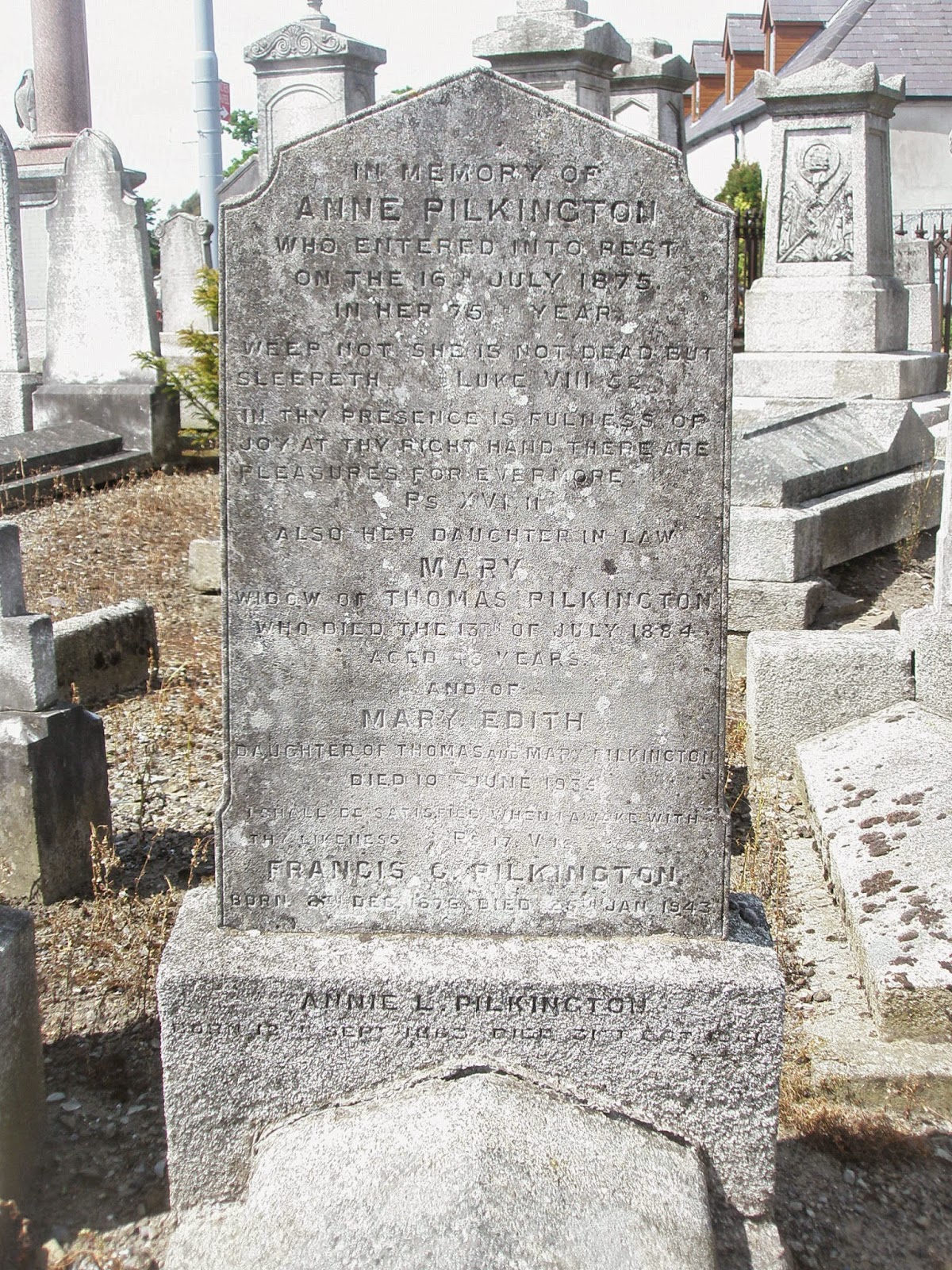
On Saturday I visited Mt. Jerome Cemetery (and here for cemetery records)at Harold's Cross, and located the group of family graves there, in a very old and run-down part of the cemetery. There are five family members representing 3 generations who are memorialised on one headstone over what may be a double plot.  Whether they are all actually buried there or not I don't know.  I'm still getting my head around the Irish tradition of remembering people on headstones even if they are buried somewhere else!


Grave of 3 of my grandfather's siblings, his mother & grandmother
Anne Pilkington (nee Keane)
Mary Pilkington (nee Haughton)
Mary Edith Pilkington
Annie Lilian Pilkington
Francis Conyngham Pilkington

The next day I visited Glasnevin cemetery, which was just a short walk from where I was staying.  What a contrast!  Glasnevin was beautiful and very well maintained.  I did a cemetery tour which had been recommended by my landlady.  It was very well worth it - as well as being very entertaining, it provided a great insight into the lives of the historical figures buried there and their part in Ireland's long struggle for independence.  My visit coincided with celebrations to mark the bicentenary of the birth of Thomas Davis, one of the founders of the Young Ireland movement, and also the Annual Commemoration of the death of Daniel O'Connell. Even though I had no personal connection to anyone buried there, I really enjoyed it.  Also had the best bowl of seafood chowder ever, in the Glasnevin café!


Celebration to mark bi-centenary of the birth of Thomas Davis,
one of the founders of the Young Ireland movement.


A walk through the beautiful National Botanic Gardens which are adjacent to Glasnevin completed the afternoon, and my last day in Dublin.

Monday, 11 August 2014

County Clare - Day 5: West Clare

Friday 9th May
Today dawned bright and sunny, but not for long.  I said goodbye to Ennis after a wonderful few days here.  I paid a visit to the Clare Museum, Ennis Friary and a quick look at a few shops, then out to the Sandfield Centre, home of birth, marriage & death registrations.  I wanted to try and get some historical certificates, but had only limited success, as the certificate I particularly wanted could not be found.

Moving on, I drove out to Kilrush, around the town and out to Cappagh with its view across to Scattery Island.  Unfortunately, Scattery opens to the public for the season on the 29th May, the day after I leave, so visiting there will have to wait for another trip. 

Then out to the Vandeleur gardens - the woods of the demesne were beautiful but the ravages of the winter storms were evident with a line of big trees uprooted.  The Vandeleur family were one of the biggest land-owning families during the 18th & 19th centuries. Their home, Kilrush House no longer exists, and the walled gardens are all that remain of the estate.  The  gardens & surrounds were lovely, having been restored and dedicated to those people who were evicted from the Vandeleur estate.


Leaving Kilrush, I headed to Kilkee and on to Kilbaha, where I met up with Pip, Karen and their little girl.  Pip is my 3rd cousin, twice removed.  (or for those who can't follow the "removed" bit, he will be a 5th cousin of my grandchildren when and if I have any!)  After a cup of tea and a chat, they brought me up to Kilbaha cottage.  Virginia and I had stayed there with Pip's parents when we visited 7 years ago.  It was lovely to be back in the old place again, the scene of so many family gatherings over the past 160 years.  The original single story cottage was given to my 2x great- aunt, Mary Anna Pilkington, on her marriage to Robert Griffin in 1851, by her uncle Marcus Keane.  The cottage has had a couple of extensions over the years, and apart from a short period of about 8 years, it has remained in the family ever since.  The cottage has changed a little since my last visit - now painted white rather than the natural stone, with a new roof, and a new wood heater in the dining room, but otherwise still the same nice homey feel.


Saturday, 9 August 2014

County Clare - Day 1: Ennis & Carrigaholt

Monday 5th May
Why is it that you would never in a million years consider drinking Guinness at home in Australia (because it tastes like ****), yet in Ireland you not only drink it and think nothing of it, but actually enjoy it too?  Anyway, it was to be a fitting end to an amazing first day.

The Rowan Tree Hostel, seemingly growing out of the River Fergus, is an elegant building which was in a former life the Ennis Club.  In the 19th century, the predominantly Protestant landed gentry and professional men of the county, including my ancestors, would have met here to enjoy a drink and a smoke, to discuss matters of import and the state of the county.  Perhaps the 19th century equivalent of the 21st century Mens Shed movement?

Rowan Tree Hostel
In its current life it is a comfortable hostel providing centrally located accommodation to visitors from far and wide, and is my base for the first stage of my Irish adventure.

So, it's from here that I set off on my first morning, headed for Carrigaholt, on the Loop Head Peninsula, by the Shannon River.  My purpose is to take part in the Famine Walk, commemorating the lives of the 41West Clare people who drowned in the Cammoge ferry disaster in December 1849.
The people were famine victims, starving and desperate, and had walked miles from their homes to catch the ferry across Poulnasherry Bay to Kilrush where they sought assistance at the Workhouse.  Unfortunately, they were turned away and with no alternative they were forced to return to their homelands.  Catching the last ferry of the day, they set out on the return journey, but misfortune struck only metres from the opposite shore, when the overcrowded and unseaworthy ferry capsized and sank.  In their poorly clad and emaciated state, they were no match for the harsh winter conditions, and if they didn't immediately drown they would have rapidly succumbed to hypothermia.

The Famine Walk began last year as part of the activities planned when Kilrush hosted the 2013 National Famine Commemoration.  The walk followed in the footsteps of those lost, and a memorial was erected on the shore at Cammoge.  It is anticipated that the walk will become an annual event as part of the Loop Head Walking Festival which takes place over the May Bank Holiday weekend.

We set off from Carrigholt as a group of 12 or so, under the guidance of Michael O'Connell, a fountain of knowledge on the Cammoge incident and on all things local - both historical and contemporary. After completing 11 or 12 kilometres, passing through locations with names familiar to me from family tales, we were compelled to abandon the walk just a kilometre or so  from the endpoint, when we were caught in an absolute deluge of rain.  Help was called for and very soon 3 cars arrived to carry us back to Carrigaholt where we retired to the Long Dock restaurant and warmed up with some delicious food and good company.


Wonderful to meet up with Paddy Waldron too, after an email correspondence of a couple of years.  Paddy is, I am convinced, related or connected to every single person in or from Ireland!

And so, back to Ennis, to meet up with Larry Brennan with whom I collaborated on the Waterpark booklet project, and an enjoyable hour or so spent with him over the afore-mentioned pint.