Showing posts with label Kilbaha. Show all posts

Tuesday, 14 August 2018

Doondahlin …

Amongst the treasure trove of memorabilia belonging to our extended family is the following picture, painted on a thin sheet of masonite.  It is labelled “Doondahlin” and bears the artists initials of ‘A.E.’.  An identical picture hangs on the wall at a cousin’s beach house.  These pictures would have been a reminder of home to my Irish relatives.


Doondahlin, date unknown, by 'A.E.'
 from Pilkington Family Collection


Doondahlin was one of the homes associated with my family back in Ireland, and which in present times is a ruin.  I had no idea who ‘A.E.’ might be, as the initials did not relate to any known family. 

The painting  was brought to mind again a few months ago when I received an email from a man in Ireland, seeking information about Doondahlin for a local history group.  So back to the family archives I went, to see what I could find out.


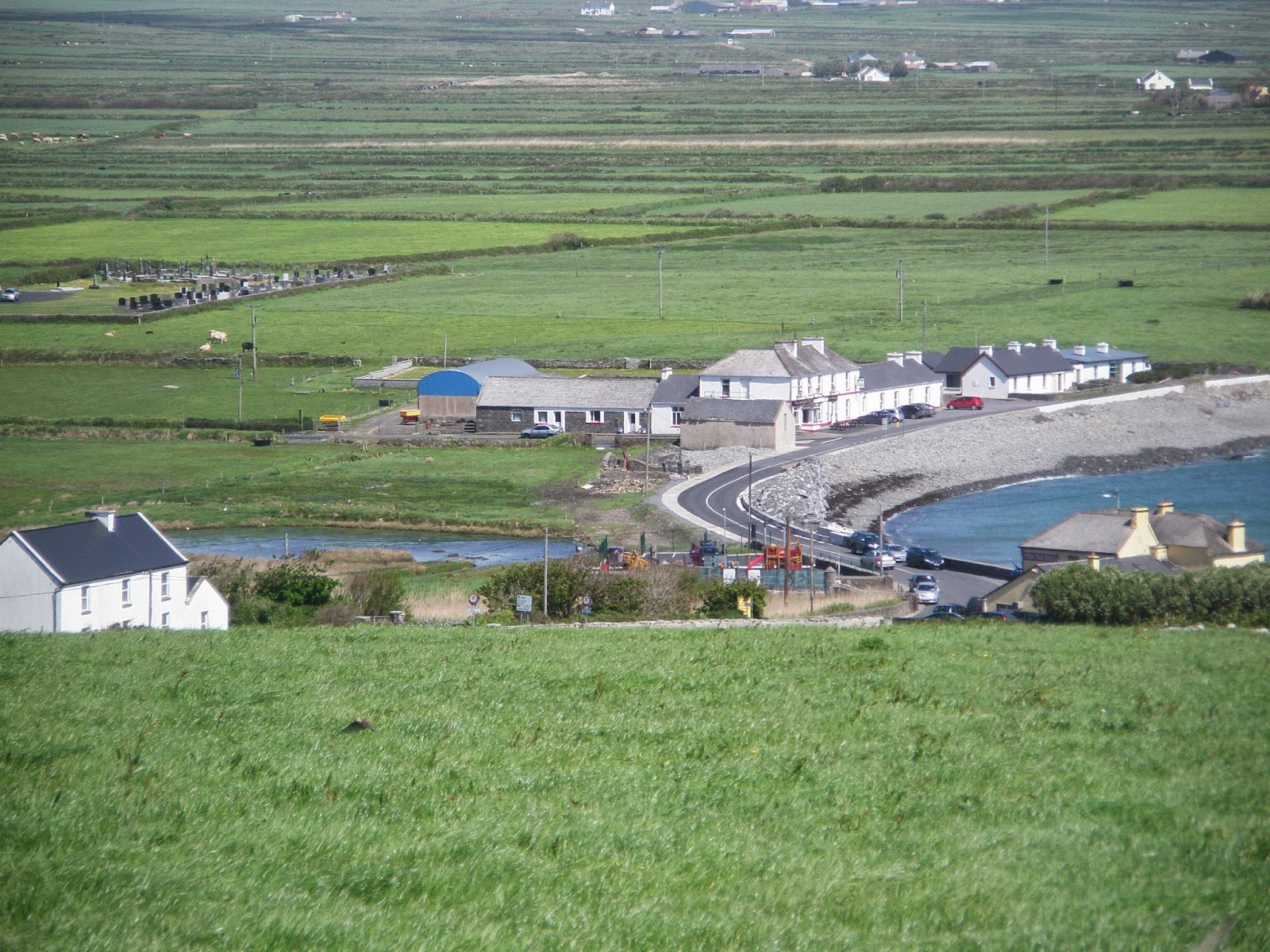
Doondahlin was the summer home of the Keane family of Beechpark, in Ennis, county Clare, Ireland.  It was built for my 3x great-uncle, the infamous Marcus Keane, probably in 1854.  An entry in his sister Charlotte’s diary in October of that year reads:  “Marcus is building a fine lodge on the cliffs at Kilbaha”.  Kilbaha is a small village by the shore of the Shannon Estuary on the Loop Head Peninsula in Clare.  These West Clare lands were the ancestral home of the Keanes (formerly O’Cahane, or Ó Catháin in Irish), and previous generations of the family had been well-respected in the area.


Doondahlin, sketched by Sarah Haughton in 1859

from Pilkington Family Collection


Marcus inherited his father’s land agency business, raising himself up the social and financial ladder by marrying the daughter of a wealthy absentee landlord, and taking on the management of his father-in-law’s extensive estates.  He became notorious during an Gorta Mór (The Great Famine) for his ruthless evictions of poor tenant farmers and the destruction of their homes. 

Doondahlin took its name from an ancient Irish hill fort, the remains of which were located on the same cliff top.  Dun Dahlin was one of four hill forts along this stretch of Loop Head Peninsula, the origins of which are based in legend.


From:
Ring-Forts in the Barony of Moyarta, Co. Clare, and Their Legends
by Thomas Johnson Westropp

Part I.—From Loop Head to Carrigaholt
(Clare Library)

Marcus Keane considered himself something of a scholar on the subject of Irish antiquities, and wrote a book published in 1867 titled “The Towers and Temples of Ancient Ireland: their origin and history discussed from a new point of view”.  Perhaps it was this interest which led him to choose this site for his ‘fine lodge’.

In his book “The Houses of Clare”, Hugh Weir describes Doondahlin as a plain L-shaped, 2 storey house, with 3-bay front, and 4-bay wing along the east side, and a single-storey 3-bay wing on the west side.  According to this newspaper advertisement, there were 3 sitting rooms, 7 bedrooms and dressingrooms, 3 servants rooms, plus kitchen, pantries, and closets. I’ve also been told that the construction of the building included a layer of turf stacked between the double brick walls to act as insulation – probably necessary protection from the Atlantic gales blowing across that exposed cliff top.

Freemans Journal 2 June 1873
from Irish newspapers at findmypast.com

The house was used as a summer residence for Marcus, his wife Louisa and their children.  After Marcus’s death in 1883, Doondahlin passed to his son Marcus junior, who owned it until it was destroyed by fire in September 1921.  Marcus the younger’s daughter Helen has written some memories of her family’s life in Clare, and she writes of vividly remembering being at Beechpark one morning when a message was brought to say Doondahlin had been burnt the previous night.  This was during the War of Independence, during which the countryside was engulfed in trouble between the Republicans and the British troops including the dreaded Black and Tans. Doondahlin was targeted presumably in retribution for the actions of Marcus Keane during the previous century.
  
Marcus Keane filed a claim for compensation to the Irish Grants Committee in 1929.  I haven’t seen his claim myself, but I am told that it outlines a previous attempt at firing Doondahlin a few months earlier, which was thwarted by the attention of the caretaker.


So, back to the picture.  While searching for information to pass on to my Irish correspondent, I did a google search for “Doondahlin” and was surprised to find the following in an on-line art catalogue – a third copy of the very same picture, together with another of the view from Doondahlin across the Shannon to Mt. Brandon in Kerry.  Both pictures were surrounded by ‘folk art frames of oystershell’.  The pair of pictures had sold for $100 just a few months previously in October 2017.


The Australian Art Sales Digest, published by John Furphy Pty. Ltd., Melbourne, Australia.

According to the catalogue, the mystery ‘A.E.’ was an Irish/Australian artist by name of Annie Eldridge. Written on the rear of this picture was ‘Mrs. Eldridge, Rosehill, Buffalo Creek, South Gippsland’.   Buffalo is in the same district in South Gippsland where my family members from Ireland settled.


After some more investigation, I came up with two possibilities.  The first was Annie Eldridge nee Farrell, an Irish woman from county Galway, who was married to a William Eldridge. The couple ran a hotel in Wodonga for many years.  This one was promising, because a Farrell family were long-standing friends of my extended family in Gippsland, and the Eldridge family of Rosehill had a son named William.  It all seemed to fit perfectly – except that the Rosehill William Eldridge was married to someone else, and this Annie didn’t fit into the Farrell family we knew.  Additionally, I could not find anything linking this couple to South Gippsland.

The second possibility was Annie Eldridge the sister of William of Rosehill.  Although this Eldridge family were of English origins, not Irish, Annie married into a family with Irish connections.  She was born in 1866, making her a contemporary of my grandfather and his brothers, and she was definitely in the right location to be acquainted with my family.  I’m still unable to connect her to Doondahlin though, so not sure what opportunity she would have had to do the painting.  

All three pictures shown here - painting, sketch and photograph - are taken from a similar vantage point on the shore of Kilbaha Bay in front of what was Kiltrellig Lodge, home of my Pilkington family.  The Pilkington sisters who lived there took in paying guests to help make ends meet.  It is not unreasonable to imagine that IF Annie Eldridge had travelled to Ireland she may have sought accommodation with the family of her friends in Australia.


The ruins of Doondahlin, 2007
© K. Vincent 2007


Tuesday, 17 January 2017

Kilbaha–here and there.


Kilbaha, County Clare, Ireland, 1871

It was one of those perfect mid-summer days in July. The balmy air was full of the sounds of summer – the hum of bees, the song of the larks as they soared high above, the gentle lapping of the waves on the shore of Kilbaha Bay, and in the distance the voices of the people gathering hay in the surrounding fields.

Anna Keane Pilkington shifted her large bulk in the chair, and rearranged her voluminous black skirts. She was enjoying the warmth of the sun against the wall of the house behind her, while in front on the lawn her grandchildren played. They had all come for the annual family holiday at Kiltrellig, the lodge her husband Thomas had built for her forty years ago.

Around her, with much jostling and rearranging of positions, her extended family gathered for a group photograph. The photographer had come from Limerick, and Anna wasn’t sure what she thought about this new-fangled contraption which would reproduce her image on paper. She wished they would just get on with it and leave her to enjoy the sunshine in peace.

Finally everyone was in place, and with an admonition to all to stay still, the photographer disappeared under the black drape of his camera and took the picture. The resulting image showed Anna staring rigidly out of the centre of the picture, surrounded by her children and grandchildren, siblings, nieces and nephews.


Family group Kilbaha 1871

To the extended family group – Pilkington, Haughton, Griffin and Keane – this was a special place. They had spent summers here in West Clare for years; long, lazy days spent exploring the rocky coastline, swimming and fishing in the Shannon, boating trips and endless picnics. At night time they gathered in one or other of the homes for a musical evening, each taking turns to perform a song or play a piece.

The children were off exploring all day, with a freedom not known to them in their ordinary lives. Holiday friendships with the local children were renewed each year and reinforced by shared interests and activity. The boys would help with the ricking or other farming chores, and the girls try their hand at the spinning, or baking a soda loaf over the fire in a nearby cabin.

As the years passed, those children grew up, their lives leading them on different paths around the world, taking the memories of those halcyon days in the West with them.

Kilbaha & Kiltrellig, co Clare, Ireland 2014
©Katrina Vincent

‘Kilbaha’, Sandy Point, Victoria, Australia, 2013

One hundred and forty-two years later, in another sea-side location on the other side of the world, I sat at the kitchen bench in a rustic holiday cottage. With me were my sisters and several cousins of varying degrees of kinship. Just back from an invigorating walk along the beach, the hot cup of tea in my hand was welcome in the cool of the late afternoon. In a frame on the wall behind us hung a faded old sepia photograph in which a large group of people posed in front of the wall of a house. A stern-looking old lady dressed in black glared out from the centre of the picture, surrounded by bearded men, women holding babies, and children of all ages.
Among those children were four small boys who grew up and journeyed half a world away to make homes and raise families in this special place.

There was much about Sandy Point to remind those men of their home in Ireland. The sea and the wild isolation of the place in all its seasons drew them and kept them here. They worked the land, battling the tides and the encroaching scrub to make a life for themselves which they could not have had in Ireland. The families supported each other through good times and bad, their children cousins and playmates. In time, the children grew up, and they too moved out into the world to follow their destinies.

Throughout the years, Sandy Point remained the focal point which drew everyone together. Families returned every year, holiday homes were built, and summers were spent swimming, fishing and boating, with picnics in favourite locations. The next generation roamed the beach and the bush without restriction. City kids joined their country cousins for the hay-making and other farm chores, while evenings were spent at one or other of the homes for barbecues or games nights. The link with the west of Clare is reflected in the names of the family homes – Ennisvale, Kiltrellig, Kilbaha.

Times have changed and Sandy Point is no longer the isolated place it was fifty years ago. Others have discovered its secrets and in summer now it becomes a bustling, crowded holiday centre. The freedom we had as children is no more. But still, our children have established their own traditions and Sandy Point continues to be the place to go to relax, refresh and recharge.

On this weekend, descendants of the four Irish men had travelled from all over Australia for a family reunion on one of the original Sandy Point farms. The autumn weather was perfect and the weekend had been full of camaraderie and reminiscence, renewing connections and celebrating the lives and traditions of all those who came before. Displayed on a large table, precious items of family memorabilia told us the tales of yesteryear - the diary of ‘Aunt Charlotte’, Anna’s youngest sister, was written in beautiful copperplate writing and was full of family adventures in West Clare.

Within the cosy warmth of ‘Kilbaha’ cottage, the ghosts of long ago mingled among us giving their blessings to this family occasion. The smell of wood smoke from the open fire replaced the salty tang of the air outside as the evening sea mist closed in. Two little girls, Anna’s four-times-great grandchildren, played quietly together on the rug, while the room echoed with the laughter and conversation of the adults. As Anna Keane Pilkington and her four small grandsons watched silently from their place on the wall, I could almost imagine a nod of her head and a softening of her gaze.
 
©Katrina Vincent 2016.  Written for Writing the Family Saga unit, University of Tasmania.


Anna Pilkington nee Keane 1802-1875
my 2x great grandmother


Sunday, 7 September 2014

The last of Clare...

Loop head continued....
After such a beautiful walk with Laura of The Long Way Round Walking Company, it was time for some refreshment.  Back in Kilbaha, I stopped at the Lighthouse Inn for a bowl of delicious chowder.  The Lighthouse Inn is the pub which was originally run by Susan Pilkington Haier, my 2x great-aunt, back in the 1860's and remained in the Haier family until recent years. I hadn't visited it before, but it was one of the things I wanted to do.  Due to its location right on the foreshore of Kilbaha Bay, the facade of the building had sustained some damage during the storms of the past winter.  Repairs were in progress, both to the Inn and the surrounding areas. 

In the pub, I happened to run into Pip, who had called in to speak to the owner.  Good to see him again, as I hadn't expected to do so.  Pip told me that another mutual cousin had just arrived in Kilbaha from England for a short stay at their family cottage.  So off I went to introduce myself to Veronica, another 4th cousin on the Keane side.  Good to make her acquaintance as well, and exchange email addresses for future reference.


I then went for a short walk around the Kiltrellig end (eastern side) of Kilbaha Bay, visited the memorial to the Grave of the Yellow Men, which was a new addition since my last visit 7 years previously.  The story of the Yellow Men is one of those recorded in our family records, being memorialised in a poem written by Amy Griffin.


The Grave of the Yellow Men

None knew from whither those drowned men came,
Swept in by the foaming tide.
So a grave was dug without a name,
Where they slumber side by side.

Their deeds are not spoken above the clay,
They perished we know not when.
Only a green mound marks today,
The Grave of the Yellow Men.

Even the wild wind sings their dirge,
While the sea birds in echo cry.
And eternally wet by the briny surge,
Is the spot where the strangers lie.

Benefiting for those whose lives are dark,
And whose death was full of pain,
But never recording stone doth mark,
The Grave of the Yellow Men.

Fond wives may have wept through the dreary night,
For the husbands they loved so well,
And at first faint dawn of welcome light,
Arisen, their beads to tell.

To hear the babes as the brightly wake,
Has father come home again?
Oh, hearts may have longed they might only break,
On the Grave of the Yellow Men.

We know they died on the raging deep,
But they lived we know not how.
Well their secret those slumberers keep,
None will ever tell it now.

But we know that the name of each lost one there,
Has been graved by his Maker’s pen.
Nor will He at last have forgotten where
To seek for The Yellow Men.

by Amy Griffin (1855-1910)

From here, I drove out to Ross and had a wander around the rocks there before driving along the coast road to Kilkee and back to Kilrush where I had hoped to catch up with Colin Keane again to see some old family papers he had brought down.  Unfortunately, Colin had decided to go out to Kilbaha for a drive, so we probably passed on the road.

the beach at Ross

I did eventually catch up with Colin over dinner in Crotty's pub, with Paddy Waldron & Kay Clancy.
After keeping myself busy all day so that I wouldn't think about it, it was finally time for my presentation that evening to Kilrush & District Historical Society.  KDHS meets once a month, with a guest speaker on a topic of interest, and Paddy Waldron has always included me on the invitation list each month via Facebook.  Earlier in the year, when I had yet again declined the invitation (Kilrush being a bit far from Melbourne to allow it), I added the comment that I would definitely be there for the May meeting.  Back came the reply from Paddy asking if I would like to be the presenter for that meeting!  After a bit of consideration I agreed, although by the time this evening had come around I was wondering why I did!  I had put together a powerpoint presentation which included some of the references and photos from our family collection, and traced the history of our branch of Pilkingtons (and Griffins) from their earliest records in Clare up to their settlement in South Gippsland.  There is a quite indistinct recording of the presentation here - apparently I needed to inhale the microphone as I spoke.  There was a good turnout for the presentation, and it seemed to be well received, although I did wonder why anyone else would be interested in our family! 


I am so sorry that I wasn't able to have a couple of days in Clare following the presentation.  In hindsight it was a big mistake, although doing so would have meant I wouldn't have had the time with Tom & Sally in London before coming home.  There were several people present who I would have very much liked to follow up with on potential family connections.  In particular, a man named ..... wait for it ..... Tom Pilkington, who lives in Ennis, and who is almost certainly a distant cousin of mine.  Tom owns land at Gortmore which has been in his family for generations.  Gortmore is an adjoining townland to Cragleigh.  In the course of my research, I have found several similarities and parallels between his family and mine, which I would very much have liked to explore further with him.

Sadly, this evening was time to say goodbye to my Clare friends - Larry, Paddy, Kay in particular, but also everyone else who had made me so welcome during my visit.  We retired back to Crotty's for a drink to unwind (well, for me to unwind), and then it was time to re-pack the bags, and toss some unnecessaries to meet to weight requirement for the flight to London.

Thursday, 4 September 2014

Loop Head Peninsula

Tuesday 27th May:
Up early today, and off to Loop Head to meet up with Laura Foley of The Long Way Round Walking Company.  I had been in contact with Laura a couple of weeks previously regarding a guided walk to see some of the places mentioned in our family diaries and letters. So today was the day, and it dawned fine and sunny.

As I had arrived back in Kilrush quite late the previous evening, I had decided to call at the supermarket first thing today to pick up some lunch supplies.  Hadn't factored in the Irish "nothing open before 0930" though! I did have some dry crackers and fruit left, so wasn't going to starve even if it was uninteresting!
I met Laura and her sister at the Loop Head carpark.  After changing into hiking boots, we set off for a 15km Loop Head hike.

Our way took us along the Shannon coast of the Loop Head Peninsula, and thanks to the weather there were clear views across the Shannon estuary to the Kerry mountains.  The similarities with the view across Waratah Bay to Wilsons Promontory at home were obvious, and I'm sure that it would have been a constant reminder of their Irish homeland for my grandfather, his brothers and cousin.

Across the Shannon to Kerry


The first point of interest was the Hanging Gardens.  In the 19th century, Henry Keane, brother of the both the infamous Marcus and my 2x great grandmother Anne, had a summer residence known as The Cabin along the Loop Head Peninsula.  On the cliff face below his home, there is a wide ledge, its location providing shelter from the Atlantic weather.  Henry Keane widened an existing crevasse in the rocks to provide access to the ledge, and created a garden here.  Nothing remains of Henry's home or garden today, but the ledge is a picture of sea-pinks and provided us a sheltered grassy spot to admire the view and enjoy the scones provided by Laura.


Entrance to Hanging Gardens


The rock wall of the Hanging Gardens
 
We continued our walk along the Shannon coast, visiting places with names familiar to me from my great-uncle Fred's diaries in 1904-05, and earlier from his cousin Amy Griffin's diary of the 1870's.
Poulnapeasta - the water dragon's lair, Moab's Washpot, Aillnagroagh and Horse Island.  Laura was a wealth of information on the area, including the botany, pointing out various plants which were edible, and identifying the wildflowers.
Moab's Washpot

Horse Island
Horse Island is not actually an island at all.  Unfortunately, it has been fenced by the current owner, so it wasn't possible to go onto it.


Aillnagroagh as sketched by Sarah Haughton in about 1859

Aillnagroagh as photographed by me in May 2014


Not a lot has changed in the past 150 years!  Minus one stack, but otherwise pretty much as it was.
 
From Horse Island, we left the coast and cut across farmland to the Atlantic side of the peninsula, coming out near Fodry, and following the cliffs back to the lighthouse. The scenery on this side was every bit as spectacular as along the Shannon.
 
The beautiful sea-pinks

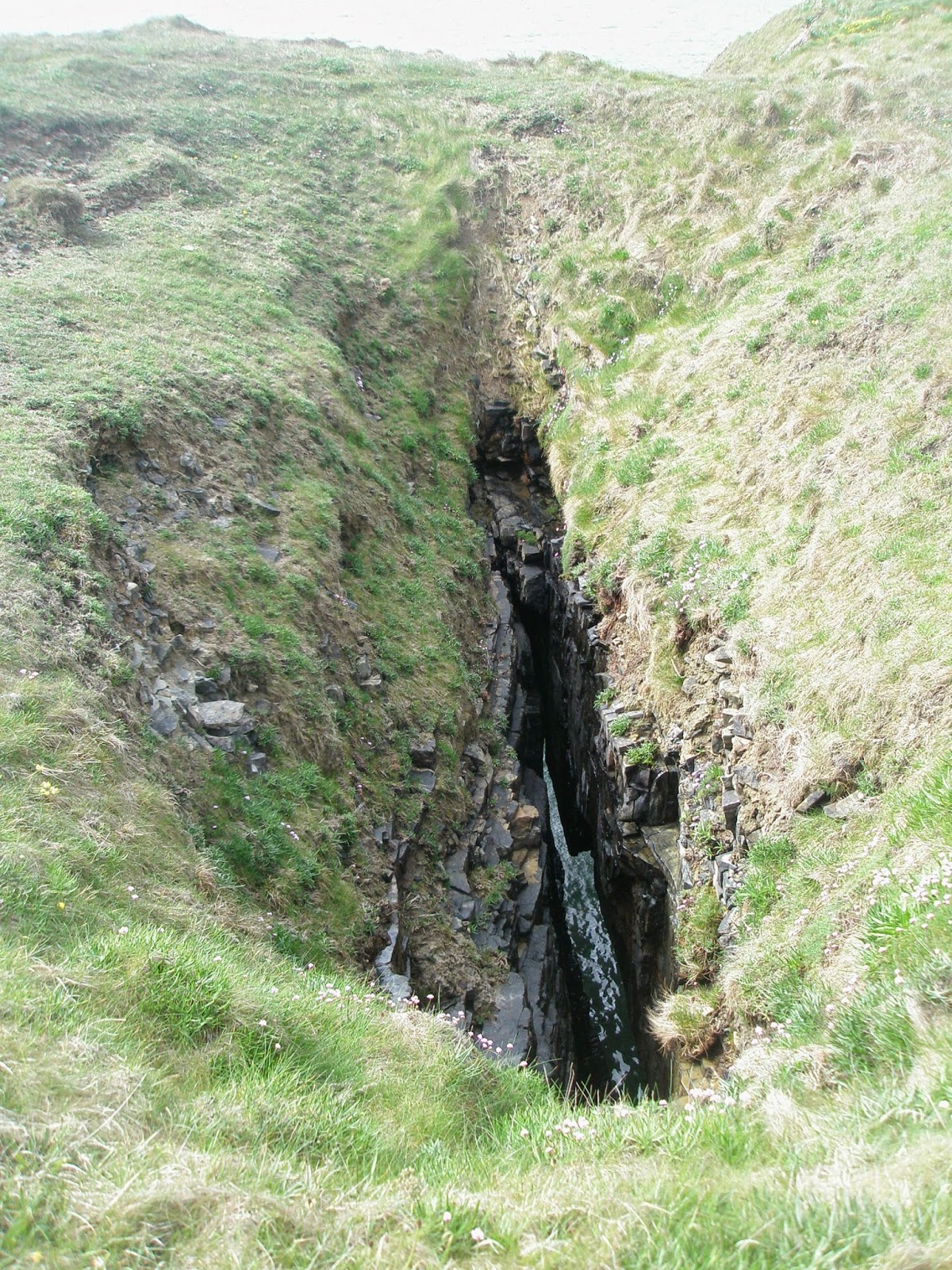
The Chimney is a rock formation mentioned in Amy's diary.  Passing through the Chimney seems to have been a challenge to be passed by all family and visitors to the Kilbaha cottage.  I was keen to see this formation, and Laura pointed it out with the advice that it wasn't something she would recommend doing.  It was quite a deep hole in the rocks leading down to the shingles below, and the potential for accidents would be significant.  I don't know how much it may have changed since Amy's days, but my impression from her writings is that it was quite a narrow opening.

The Chimney
Further round we came to Gull Island, so named for the masses of gulls nesting on the rock ledges along the sides.  With this came spectacular views back to the lighthouse and Lovers Leap - the gap between the mainland and Diarmuid & Grainne's Rock, also known as Cuchullins Leap.  This was the location of Amy Griffin's daring crossing in a makeshift crane which hoisted her across.
Gull Island

Lighthouse & Lovers Leap
The birdlife along the cliffs on the way back was amazing. Apart from the gulls, there was a large colony of Guillemots nesting. These birds only spend time on land while nesting, coming ashore in May and leaving their nests again in August.
 
It was a great walk on a beautiful spring day, tracing the footsteps of my forebears, in the places they loved and wrote about.  Thanks to Laura for helping me to add another layer of memories to those passed down the generations.

Guillemot egg


unknown wildflower

Saturday, 16 August 2014

Dublin part 1...

The drive to Dublin was easy, as I took the motorway which has speed limit of 120klms. I had planned to take a more scenic route, but leaving later than intended, I took the most direct route instead.  Driving in Ireland is no problem at all, and the coding of the roads - M=motorway, N= national route, R= regional route, L=local road - with fairly standard speed restrictions for each, make it very stress-free.  Plus, unlike home, Irish drivers for the most part seem to be happy to share the road with everyone (and everything).

Only one small hiccup the next day - received a message from my husband at home telling me the bank wanted to speak to me about a possible fraudulent transaction on my credit card. They wouldn't give him any details, so I had to call them.  The item at issue was the €2.40 electronic toll fee which I had paid on-line.  So my short trip on the tollway into Dublin ended up costing me around $30!

I arrived in Dublin about 6.30 pm on Sunday, finding my accommodation at Botanic View B&B in Glasnevin, without too much difficulty.  This was a great location just north of the city, bus stop almost at the door and just 10 mins into O'Connell St.  Also not too far to walk, about 25 mins, which I did on a couple of mornings.  The area was also well-served with pubs, restaurants and take-away food outlets, so was very convenient for me as all within a few minutes walk.

My purpose in Dublin was to visit the National Library, National Archives and Church of Ireland library, looking for records relating to our family history.

Monday morning got off to a slow start due to difficulties with my Irish SIM card in my phone.  After only a few days, I couldn't make any calls - apparently out of credit even though the card I had purchased was for unlimited calls for a month.  After 2 hours of on-line chat help with O2, finally sorted - just needed to change a setting in my phone and I was back in touch with the world.  I then set about establishing some contacts in Dublin.

First was a coffee date with Margaret Gallery, with whom I had been in email contact.  Margaret and I have a mutual connection via the Stacpoole family.  Additionally, her Kenny family succeeded the Pilkington family at Cragleigh in the mid-1820's, so we have some shared research interests. We met up at a little coffee shop not far from the National Library, and Margaret had also invited Paddy Waldron and Colin Keane.  Colin is a 4th cousin of mine, a descendant of Francis Nathaniel Keane of Hermitage.  He is very knowledgeable on all Keane family matters and has a large collection of family memorabilia.

The following day I had lunch at the National Library café with Tom Pilkington's cousin Gail.  Gail is currently studying a genealogy course, and had offered me any help I needed negotiating the library and archives.  Her connection to Tom is via his mothers family, while mine is through his fathers side.

In the evening I had the absolute pleasure of meeting Tim and Aine Haier.  Tim is also a 4th cousin, or more correctly a half-4th cousin, if there is any such thing.  His great-grandmother, "Old Susie" who features in Fred Pilkington's diaries and family letters, was a half-sister of my great grandfather.

Tim and Aine had lots of information to share about Kilbaha, Kiltrellig and the connection between the Haiers and the Pilkingtons.  Tim has lots of memories of growing up in the area, where his dad ran the pub which was originally Susie's (c1867), and is now the Lighthouse Inn.  He recalls playing in the stables at Kiltrellig and being sent up to Miss Annie with messages, telegrams etc.  The Haier family purchased Kiltrellig after Aunt Annie died.  It was a thoroughly enjoyable couple of hours spent with them.

Finished off the day in Hedigan's Brian Boru pub, just across the road from my B&B, enjoying a whiskey and some traditional Irish instrumental music.


Tuesday, 12 August 2014

County Clare - Day 6 & 7: Kilbaha

Saturday 10th May
Woke up very snug in my bed this morning and decided to stay put for a while.  The weather outside was atrocious, rain and blowing a gale.  To say nothing of COLD!!!  Goodbye to any plans for today - I had hoped to visit the lighthouse, but no point in this weather.

Up later, and a quick trip out to the car (brrrr!) to bring in my books and laptop.  I set myself up on the dining room table in front of the heater and spent a lovely day working on family history and doing the finishing touches to my presentation for Kilrush & District Historical Society.  What better place to write about family history than in this place which has played such a part in it?

The little wood heater took the chill out of the air, but by late afternoon it was cooling off and I found a single bar radiator which I set up near my feet.  What I would have given for my nice warm slippers!  Pip and Karen arrived in the evening and we spent a couple of hours over a meal and a chat.

Sunday 11th May
Quite sunny this morning for a change, but still cool and windy.  The sun porch at Kilbaha was a great spot to enjoy breakfast and a morning cup of tea.

Loop Head Lighthouse


Up to the Loop Head Lighthouse after breakfast - clear enough for a spectacular view right across the Shannon to the Kerry mountains.  Did the lighthouse tour, and had a quick walk around the perimeter before returning to Kilbaha.  I stopped by the Kiltrellig graveyard, just to get the feel.  Mary Anna(Pilkington) Griffin died in 1887, and her son Bob Griffin who died at Kiltrellig in 1904 are both buried either there in the graveyard, or just over the fence in the adjacent Kiltrellig land.  Family diaries confirm their burials, but there is nothing there to mark exactly where.  The cemetery backs onto Kiltrellig so it provided a view over what would have been the home paddocks and a good idea of what the outlook from Kiltrellig Lodge over the Shannon estuary would have been like.  Kiltrellig Lodge was the summer residence of the Pilkington family, built by Thomas Pilkington in  1834.  It became the permanent family home for the unmarried Pilkington siblings after the death of their parents in 1884, and remained the family home until the death of the last of my grandfathers siblings, Annie Pilkington, in 1961.


Kiltrellig Lodge c1950

 The house was in a state of disrepair at the time of Annie's death.  The story goes that as the house became more and more dilapidated, she would just close it off room by room until at the end she was living in just 2 habitable rooms.  It was eventually demolished.

I then met up with Pip and Karen again, and Pip took me for a walk around the cliff tops, past the ruins of Doondahlin, to the Turret and the Rock pool.  The scenery really is spectacular.
 
Cliff-top view

The Rock Pool


The Turret - built as a smoking house for the men of Doondahlin

After our walk, we met up with Seamus and Ailish Connolly, friends of Pip's who live with their young family just a short way up the road from Kilbaha cottage. Seamus knew all about Kiltrellig and the Pilkington's, mentioned Miss Annie and Miss Edie, even though both they and the house would have been long gone before he was even born!  Enjoyed a cup of tea at their house, and heard about Ailish's plans to open a gallery with a friend.  This is now up and running as Kilbaha Gallery & Crafts, which also incorporates a heritage centre named for a local identity, Henry Blake.

It was difficult to tear myself away from their hospitality, but the drive to Dublin wasn't going to get any shorter, so eventually I made my goodbyes and left.


Kilbaha & Kiltrellig
Kilbaha cottage at left.  The two single storey buildings on the right are the Kiltrellig cottages and are still owned by family connections.

Monday, 11 August 2014

County Clare - Day 5: West Clare

Friday 9th May
Today dawned bright and sunny, but not for long.  I said goodbye to Ennis after a wonderful few days here.  I paid a visit to the Clare Museum, Ennis Friary and a quick look at a few shops, then out to the Sandfield Centre, home of birth, marriage & death registrations.  I wanted to try and get some historical certificates, but had only limited success, as the certificate I particularly wanted could not be found.

Moving on, I drove out to Kilrush, around the town and out to Cappagh with its view across to Scattery Island.  Unfortunately, Scattery opens to the public for the season on the 29th May, the day after I leave, so visiting there will have to wait for another trip. 

Then out to the Vandeleur gardens - the woods of the demesne were beautiful but the ravages of the winter storms were evident with a line of big trees uprooted.  The Vandeleur family were one of the biggest land-owning families during the 18th & 19th centuries. Their home, Kilrush House no longer exists, and the walled gardens are all that remain of the estate.  The  gardens & surrounds were lovely, having been restored and dedicated to those people who were evicted from the Vandeleur estate.


Leaving Kilrush, I headed to Kilkee and on to Kilbaha, where I met up with Pip, Karen and their little girl.  Pip is my 3rd cousin, twice removed.  (or for those who can't follow the "removed" bit, he will be a 5th cousin of my grandchildren when and if I have any!)  After a cup of tea and a chat, they brought me up to Kilbaha cottage.  Virginia and I had stayed there with Pip's parents when we visited 7 years ago.  It was lovely to be back in the old place again, the scene of so many family gatherings over the past 160 years.  The original single story cottage was given to my 2x great- aunt, Mary Anna Pilkington, on her marriage to Robert Griffin in 1851, by her uncle Marcus Keane.  The cottage has had a couple of extensions over the years, and apart from a short period of about 8 years, it has remained in the family ever since.  The cottage has changed a little since my last visit - now painted white rather than the natural stone, with a new roof, and a new wood heater in the dining room, but otherwise still the same nice homey feel.