 |
| Sandy Point beach 2018 ©kaypilk |
My father grew up at Sandy Point, on the shores of Waratah Bay in South Gippsland, where his father with two brothers and their cousin, had settled in the 1890’s after emigrating from Ireland. The four families had grown up together and remained close. My father’s path in life took him away from the land, and his family property had been sold after the death of my grandfather. Several of his cousins remained on their family farms, and others returned regularly for holiday visits, so it was natural for my parents to keep the connection.
One of my earliest memories, when I would have been about 3 or 4 years old, is of crawling through tea-tree scrub with Mum & Dad as they checked out the advantages and disadvantages of various blocks in the new Playground Estate, recently developed on the dunes separating the beach from the farmland behind. Eventually, they chose a block for the view it provided over the farmland, with Shallow Inlet and the South Gippsland hills beyond. They named this property "Kiltrellig" in memory of the old Pilkington family summer home in the west of county Clare, Ireland.
Then came construction of "The Shack", built by Dad out of Volkswagen packing cases. This would have been a cheap source of timber to use for the floor and exterior cladding. The interior of the frame was unlined, but covered with bitumen-impregnanted brown paper sheeting to cover any gaps and reduce damp. The Shack was built on what Mum referred to as "the leafy lane', which had been the old track connecting the original family homes before the roads were made.
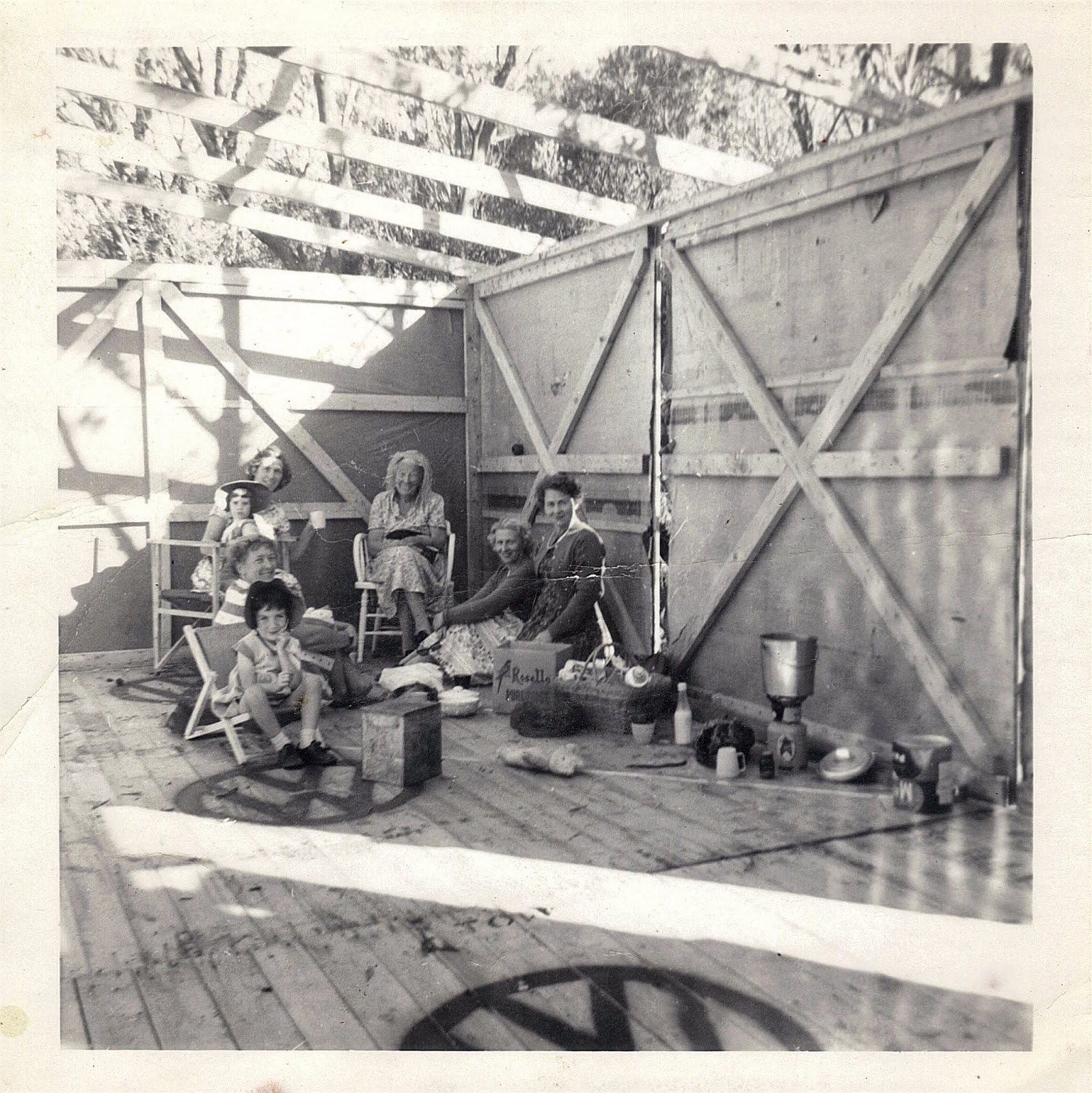 |
| Entertaining relatives at The Shack under construction c1961-2 Me on the deck chair in front. |
Pilkington Family Collection ©
While the Shack was being built, our family stayed with relatives at ‘Gyndahnook’, one of the original homes. A highlight for me was taking the big brass gong off the wall and ringing it to let Dad know down the paddock that meals were ready.
While the Shack was being built, our family stayed with relatives at ‘Gyndahnook’, one of the original homes. A highlight for me was taking the big brass gong off the wall and ringing it to let Dad know down the paddock that meals were ready.
 |
| Brass dinner gong in the kitchen at Gyndahnook |
from Pilkington family collection ©
Although small, the Shack provided all the comforts our family of seven needed. It was a single room construction, cleverly designed with bunks built in at either end, and shelving units dividing the sleeping areas from the living area. The eight bunks meant that one of us could have a friend come to stay. Mum used large posters to provide a colourful display on the walls. These posters were put out by Victorian Railways or TAA (airline) to promote tourist destinations. I seem to recall there was one for wildflowers in WA, another for skiing at Mt. Beauty, and one of the memorial cross at Mount Macedon, among others. The image below is representative of the style of posters of the times.
Although small, the Shack provided all the comforts our family of seven needed. It was a single room construction, cleverly designed with bunks built in at either end, and shelving units dividing the sleeping areas from the living area. The eight bunks meant that one of us could have a friend come to stay. Mum used large posters to provide a colourful display on the walls. These posters were put out by Victorian Railways or TAA (airline) to promote tourist destinations. I seem to recall there was one for wildflowers in WA, another for skiing at Mt. Beauty, and one of the memorial cross at Mount Macedon, among others. The image below is representative of the style of posters of the times.

Victorian Railways, and E.H. Turnor Studio, Artist. Wilson's Promontory, Victoria, Australia [picture] / E.H. Turnor., 1930.
There was no electricity at Sandy Point at that time. We had gas lighting, kerosene fridge, tank water and a little pot-belly wood stove for heating when we needed it. Mum produced our meals on a small gas hotplate and griller, or outside on the barbecue she had made herself from old farm implements. Bathroom facilities were non-existent. Hot water came from the kettle. The toilet was a “long drop” dug by Dad, and enclosed in a hessian frame outside. We cleaned our teeth in a cup of water and washed when required in a plastic tub. Once a week or so, we would head to the caravan park to shower, putting sixpence into the metre for hot water. This was a communal effort – one shower for the girls and one for the boys - as Mum wanted to get the most out of her sixpences.
Our days were spent at the beach, exploring the bush, or with cousins on their farms. Day trips and picnics to nearby locations, depending on the wind direction. East wind - off to the Prom, where the beaches would be sheltered. Westerly - around the coast to Walkerville which would be similarly sheltered. My memories are of sunburn, insect bites and stubbed toes, all par for the course of an Australian bush summer. Shoes were unheard of - we trod those gravel roads, hot beach sands and tracks through the scrub in our bare feet without complaint. We never gave a thought to snakes. Dad always said we didn't need to worry about snakes because they were more scared of us than we were of them. I doubt it, but whatever, we rarely saw them even though they must have been plentiful.
At night, we stayed out until dark. Later, we would visit with relatives, or play scrabble or card games around our little table in the Shack. Then off to bed, drifting off to sleep to the sound of the surf or the wind through the trees, and the smell of burning mosquito coils in our noses. Dad could pinpoint the moment the tide turned just by listening to the sound of the surf.
 |
| Cleaning out The Shack in 2016 ©kaypilk |
In reality, the time we spent in The Shack was only about 7 or 8 years, before Mum & Dad built a more substantial home. But to me as a small girl it seemed like a lifetime. After the house was built, the Shack became the domain of my older brothers. It then served as a storage shed, garden shed and more recently a home to multiple species of wildlife. The Shack is still there, although now in a state of disrepair. From time to time we have had half-hearted plans to rejuvenate it, but for the moment it remains as a reminder of the many happy memories created within its walls.
 |
| The Shack 2016 ©kaypilk |


