Showing posts with label summer. Show all posts

Monday, 9 January 2023

Holidays...

January ... Christmas over and done with and on to the serious business of Summer holidays!

As a child, the long summer break seemed to stretch endlessly in front of us. I've written about our childhood summer holidays previously in The Shack. 

Being a clergyman, Christmas was a busy time of year for Dad, but come Boxing Day he took his three weeks annual leave, loaded up the car and the family headed off to Sandy Point.  We've continued that tradition as adults, spending time at Sandy Point every year.

This year, for a couple of reasons, there will be no Sandy Point summer holiday for me.  That's a whole other story for another time (maybe). In honour of summer holidays, I thought I would reproduce a story written by my mother about a holiday journey many years ago before I was born.

Between 1951 and the end of 1954, my father was the Vicar of St James Anglican Church in Orbost, in East Gippsland, Victoria.  Orbost was a remote township, almost 400 kilometres from Melbourne, and 300 kilometres from Sandy Point, so it was a long drive to undertake in the heat of summer with small children on board.  Roads of the 1950's would have been a lot more challenging than they are today.


I'm not sure from Mum's account which year exactly this event took place, but she would have either been pregnant and with two small boys aged 3 and 1, or they would have had 3 children under the age of 5.  Here is Mum's story:  

On one memorable holiday we packed the car full to overflowing with children and belongings, besides a trailer which Father managed to borrow from a friend and set off. Oh, the joy of freedom!  We had travelled a considerable distance when we realised that all was not well with the trailer.

A tyre had burst. Father changed it and we set off once more only to find another tyre gone not long afterwards.  We called in to a garage where repairs were made and set off on the longest stretch between civilisation, late in the afternoon.  Before long, we had another trailer blow-out.  This was too devastating, for we were miles from anywhere, and besides all garages were shut by then.

We considered our fate, and thanked God for the kind friend who had lent us a tarpaulin - at least THAT could not go wrong! Fortunately, Father's scout training stood us in good stead.  He made a nice little fire in true bushman's style, then went hunting for some water in what I considered a most unlikely spot, whilst I set about cooking some tea. Oh, how fortunate we had some provisions with us.

Afterwards, Father rigged the tarpaulin up beside the car where we curled up for the night.  The children had beds made up in the car, so we were all reasonably comfortable.

Next morning, after a little breakfast, Father decided to unhook the car and drive back to the nearest town, six miles away.  The loaded trailer could not be left unattended, so the children and I stayed along the roadside with it.

After a while the novelty of the situation began to pall.  There was nothing for the nips to do, and the day was becoming increasingly hot. Something had to be done to remedy the situation until Father returned.

Suddenly I remembered I had my violin in the luggage.  What a blessing! We then played gypsies. I fiddled nursery rhymes whilst the children sang lustily at the tops of their voices.  When we had gone through the repertoire of children's songs, we started on hymns.

Being on an inter-state highway, the reaction of passing motorists afforded much amusement.  I'll bet there were a lot of cricked necks that day - they were still looking backwards as they drove out of sight!

In due course Father returned, and we set off without further mishap until we approached our destination. Here we became bogged in sand 14 times over the last mile.

-------------

This story was originally published in a weekly column titled 'Within the Vicarage Walls' which my mother wrote for "The Anglican" newspaper in the late 1950's and early 1960's.

My mother aged 18, 1941
Pilkington Family Collection

That last mile or so of the trip was literally a sand track bulldozed through the bush. Becoming bogged was a matter of when, not if, up until the mid-60's when a gravel road was made.

The road to Shallow Inlet
Pilkington Family Collection


Tuesday, 30 April 2019

A Picnic When Cars Were Few ... a Trove Tuesday post.

If the internet had been around 50 or 60 years ago, I’m sure my mother would have been a blogger.  She loved to write, and for a few years when we children were small, she wrote a weekly column in a national church newspaper chronicling our family life.  I intend to share extracts of those in future posts. 

In 1961, mum had an article published in the Literary Supplement which came with The Age newspaper every Saturday.  She received a cheque in the amount of £6/6/- as payment, a sum which would have been a welcome addition to the household income.  Here is her story, a recollection of her own childhood days in the 1920s-30s.


A PICNIC WHEN CARS WERE FEW

by Dorothy Pilkington

It is generally accepted as the prerogative of double chins, walking sticks and snowy hair to reflect upon bygone days.  The excusable exception is surely when one’s eight-year-old pride and joy naively inquires, “Mummy, did you live in the olden days?”  “What olden days?” I exploded, as a plate I was wiping crashed to the floor in profound sympathy.  Yes, what indeed?

Much later, when the child had long since forgotten the query, it remained with me, an impression searing into my consciousness the realisation that there is now another generation which has the audacity to relegate a 38-year-old to “the olden days” in precisely the same manner in which we regarded our parents in days of yore!

Never will my family experience the thrill of a large family picnic, held twice yearly (Boxing Day and Easter Monday, rain or shine), in horse-drawn furniture vans rattling along the Point Nepean Road to the mecca of all picnic parties of the era, at the Mordialloc Creek.

There were aunts, uncles, cousins, grandparents and in-laws of all degrees; everyone highly attuned in eager anticipation of the day ahead.  The flappers pioneering the “new look” of the Charleston period, giggling in innocent delight at their daring.  The mothers dressed sombrely in blouse and long skirts, with parasols and big, floppy hats with fly nets attached; the older men with their droopy moustaches and beards, wearing hairy tweeds, heavily steeped in a combined aroma of pipe tobacco and beer.

For the female members of the family the day was the culmination of many weeks’ culinary preparations.  The delightful unpacking of lunch baskets, full of delectable mysteries, never failed to make our child eyes goggle, and set our salivary mechanism working overtime.

We children were critically appraised by the various aunts, while our rate of growth since the last occasion appeared to provide them with much comparative material to aid their wholesome exclamations: “My, hasn’t she grown. She’s getting so like you, dear!”

For the afternoon activities, races of all descriptions were organised by the younger men, with the elder sitting on the sidelines contentedly drawing on their pipes and dozing in the sunshine. Huge quantities of boiled lollies were consumed by the youngsters, vying with each other for the most colorful patterns.

Sunset was the curfew for our departure, tired, sticky, full beyond measure with a sense of happiness complete; snuggling upon the laps of grown-ups in sheer exhaustion; the lusty singing of nostalgic airs to the accompaniment of a piano accordion, wafting us to sleep with the gentle clip-clop, clip-clop of the faithful horses’ shod hooves.

Curses upon the motor car, even then finding favour; spewing oil and grease upon the road until the fateful night when one of the horses slipped …

As I speed along the Nepean Highway today in all the splendour of gleaming chrome and superbly sprung luxury, keeping apace with the modern tempo of living, I hark back in wonder to those leisured days.

Would that my children could experience but one facet of the life we once glimpsed – yet so briefly.

published in The Age, 22nd July 1961.


Mordialloc appears to have been a popular destination for a day at the seaside, being easily accessible by train, or by the Point Nepean Road (now Nepean Highway).  Not only family gatherings, but Sunday School picnics, annual trade and company outings were popular, regularly reported in the newspapers of the day.

"WHERE TO SPEND A HOLIDAY." The Argus (Melbourne, Vic. : 1848 - 1957) 
23 December 1924: 7. Web. 28 Apr 2019 <http://nla.gov.au/nla.news-article2090237>. 


Mordialloc was also noted for its annual carnival held over the summer holiday period from 1924 through to 1939.  It featured parades, amusements, side-shows, sporting events and other activities and was a popular holiday attraction.  The history of the Mordialloc Carnival has been written about here in the Kingston Local History website.


"HOLIDAY RESORTS." The Argus (Melbourne, Vic. : 1848 - 1957) 
10 January 1927: 15. Web. 28 Apr 2019 <http://nla.gov.au/nla.news-article3831327>. 


Mum’s mother, my grandmother, was one of five daughters of John Grant and Elizabeth nee Duffy.  John’s own grandfather, also John Grant, had settled in Brighton in the 1840’s, and ran a successful carrier business.  The extended Grant family were well established in the district, with four generations all raising families there.  The younger John, and his brother William, both had carrier businesses.  It was likely company vans which ferried the families to their bi-annual picnics.  I have tried to find a newspaper reference to the accident involving the horse slipping on the greasy road, but without a specific date range it has proved unsuccessful.

Postcard of Mordialloc Creek 1919 
http://handle.slv.vic.gov.au/10381/367432

Monday, 25 February 2019

The Shack …

Nearing the end of February, and the official end of summer – although hopefully we will still have several more weeks of summery weather.  This has prompted me to think back to summers past, and childhood memories of “The Shack” which was the base for our summer holidays at Sandy Point.


Sandy Point beach 2018 ©kaypilk 

My father grew up at Sandy Point, on the shores of Waratah Bay in South Gippsland, where his father with two brothers and their cousin, had settled in the 1890’s after emigrating from Ireland.  The four families had grown up together and remained close.  My father’s path in life took him away from the land, and his family property had been sold after the death of my grandfather.  Several of his cousins remained on their family farms, and others returned regularly for holiday visits, so it was natural for my parents to keep the connection.

One of my earliest memories, when I would have been about 3 or 4 years old, is of crawling through tea-tree scrub with Mum & Dad as they checked out the advantages and disadvantages of various blocks in the new Playground Estate, recently developed on the dunes separating the beach from the farmland behind.  Eventually, they chose a block for the view it provided over the farmland, with Shallow Inlet and the South Gippsland hills beyond.  They named this property "Kiltrellig" in memory of the old Pilkington family summer home in the west of county Clare, Ireland.

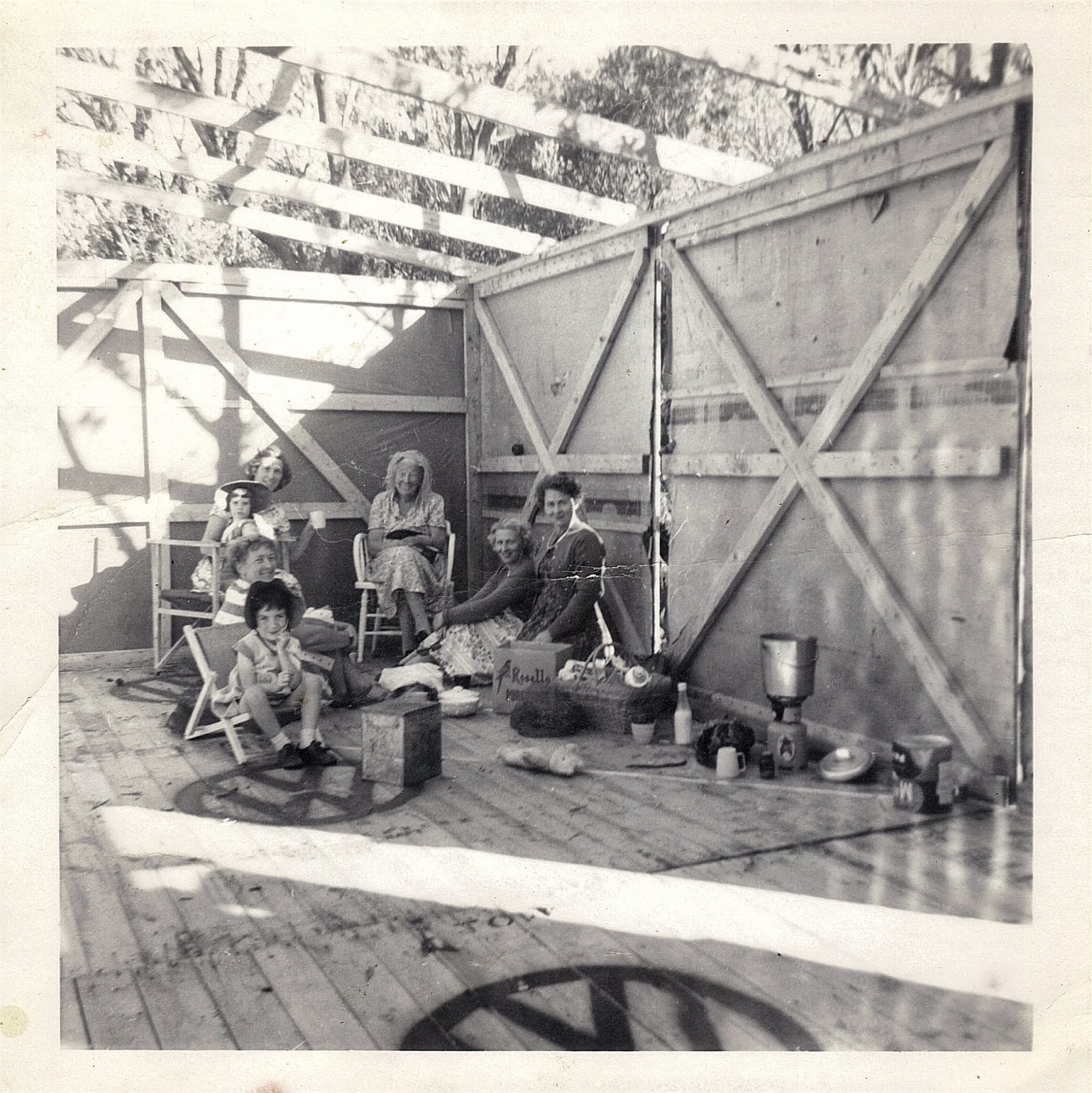
Then came construction of "The Shack", built by Dad out of Volkswagen packing cases.  This would have been a cheap source of timber to use for the floor and exterior cladding.  The interior of the frame was unlined, but covered with bitumen-impregnanted brown paper sheeting to cover any gaps and reduce damp.  The Shack was built on what Mum referred to as "the leafy lane', which had been the old track connecting the original family homes before the roads were made.

Entertaining relatives at The Shack under construction c1961-2
Me on the deck chair in front.
                                                                                                        Pilkington Family Collection ©

While the Shack was being built, our family stayed with relatives at ‘Gyndahnook’, one of the original homes.  A highlight for me was taking the big brass gong off the wall and ringing it to let Dad know down the paddock that meals were ready.
Brass dinner gong in the kitchen at Gyndahnook
                                                                                                      from Pilkington family collection ©

Although small, the Shack provided all the comforts our family of seven needed. It was a  single room construction, cleverly designed with bunks built in at either end, and shelving units dividing the sleeping areas from the living area. The eight bunks meant that one of us could have a friend come to stay.  Mum used large posters to provide a colourful display on the walls. These posters were put out by Victorian Railways or TAA (airline) to promote tourist destinations.  I seem to recall there was one for wildflowers in WA, another for skiing at Mt. Beauty, and one of the memorial cross at Mount Macedon, among others. The image below is representative of the style of posters of the times.


Victorian Railways, and E.H. Turnor Studio, Artist. Wilson's Promontory, Victoria, Australia [picture] / E.H. Turnor., 1930.

There was no electricity at Sandy Point at that time. We had gas lighting, kerosene fridge, tank water and a little pot-belly wood stove for heating when we needed it. Mum produced our meals on a small gas hotplate and griller, or outside on the barbecue she had made herself from old farm implements. Bathroom facilities were non-existent. Hot water came from the kettle. The toilet was a “long drop” dug by Dad, and enclosed in a hessian frame outside. We cleaned our teeth in a cup of water and washed when required in a plastic tub. Once a week or so, we would head to the caravan park to shower, putting sixpence into the metre for hot water. This was a communal effort – one shower for the girls and one for the boys - as Mum wanted to get the most out of her sixpences.

Our days were spent at the beach, exploring the bush, or with cousins on their farms.  Day trips and picnics to nearby locations, depending on the wind direction.  East wind - off to the Prom, where the beaches would be sheltered.  Westerly - around the coast to Walkerville which would be similarly sheltered.  My memories are of sunburn, insect bites and stubbed toes, all par for the course of an Australian bush summer.  Shoes were unheard of - we trod those gravel roads, hot beach sands and tracks through the scrub in our bare feet without complaint.  We never gave a thought to snakes.  Dad always said we didn't need to worry about snakes because they were more scared of us than we were of them.  I doubt it, but whatever, we rarely saw them even though they must have been plentiful.

At night, we stayed out until dark.  Later, we would visit with relatives, or play scrabble or card games around our little table in the Shack.  Then off to bed, drifting off to sleep to the sound of the surf or the wind through the trees, and the smell of burning mosquito coils in our noses.  Dad could pinpoint the moment the tide turned just by listening to the sound of the surf.

Cleaning out The Shack in 2016 ©kaypilk


In reality, the time we spent in The Shack was only about 7 or 8 years, before Mum & Dad built a more substantial home.  But to me as a small girl it seemed like a lifetime.  After the house was built, the Shack became the domain of my older brothers.  It then served as a storage shed, garden shed and more recently a home to multiple species of wildlife.  The Shack is still there, although now in a state of disrepair.  From time to time we have had half-hearted plans to rejuvenate it, but for the moment it remains as a reminder of the many happy memories created within its walls.


The Shack 2016  ©kaypilk