Showing posts with label Waratah Bay. Show all posts

Monday, 25 February 2019

The Shack …

Nearing the end of February, and the official end of summer – although hopefully we will still have several more weeks of summery weather.  This has prompted me to think back to summers past, and childhood memories of “The Shack” which was the base for our summer holidays at Sandy Point.


Sandy Point beach 2018 ©kaypilk 

My father grew up at Sandy Point, on the shores of Waratah Bay in South Gippsland, where his father with two brothers and their cousin, had settled in the 1890’s after emigrating from Ireland.  The four families had grown up together and remained close.  My father’s path in life took him away from the land, and his family property had been sold after the death of my grandfather.  Several of his cousins remained on their family farms, and others returned regularly for holiday visits, so it was natural for my parents to keep the connection.

One of my earliest memories, when I would have been about 3 or 4 years old, is of crawling through tea-tree scrub with Mum & Dad as they checked out the advantages and disadvantages of various blocks in the new Playground Estate, recently developed on the dunes separating the beach from the farmland behind.  Eventually, they chose a block for the view it provided over the farmland, with Shallow Inlet and the South Gippsland hills beyond.  They named this property "Kiltrellig" in memory of the old Pilkington family summer home in the west of county Clare, Ireland.

Then came construction of "The Shack", built by Dad out of Volkswagen packing cases.  This would have been a cheap source of timber to use for the floor and exterior cladding.  The interior of the frame was unlined, but covered with bitumen-impregnanted brown paper sheeting to cover any gaps and reduce damp.  The Shack was built on what Mum referred to as "the leafy lane', which had been the old track connecting the original family homes before the roads were made.
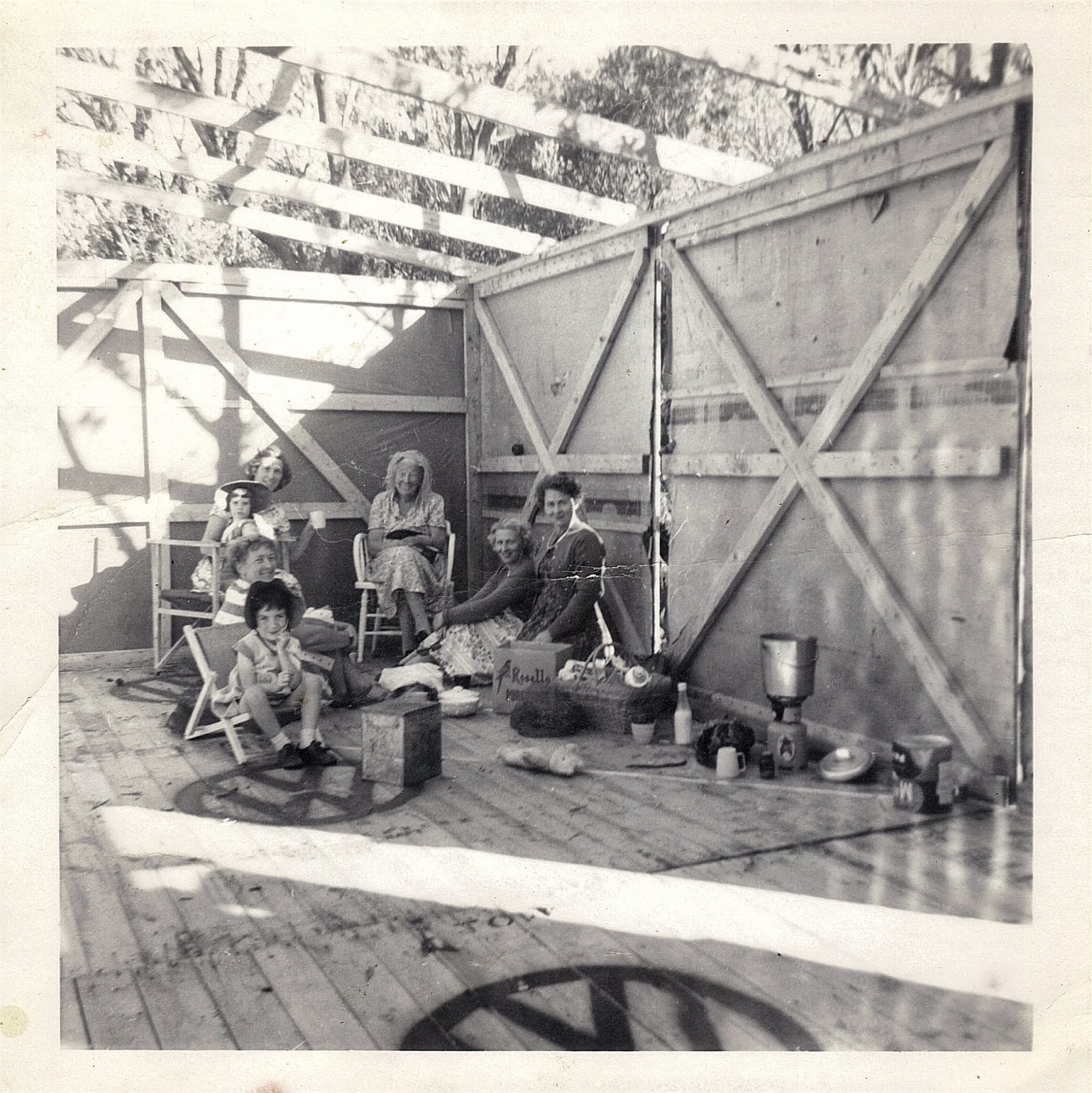
Entertaining relatives at The Shack under construction c1961-2
Me on the deck chair in front.
                                                                                                        Pilkington Family Collection ©

While the Shack was being built, our family stayed with relatives at ‘Gyndahnook’, one of the original homes.  A highlight for me was taking the big brass gong off the wall and ringing it to let Dad know down the paddock that meals were ready.
Brass dinner gong in the kitchen at Gyndahnook
                                                                                                      from Pilkington family collection ©

Although small, the Shack provided all the comforts our family of seven needed. It was a  single room construction, cleverly designed with bunks built in at either end, and shelving units dividing the sleeping areas from the living area. The eight bunks meant that one of us could have a friend come to stay.  Mum used large posters to provide a colourful display on the walls. These posters were put out by Victorian Railways or TAA (airline) to promote tourist destinations.  I seem to recall there was one for wildflowers in WA, another for skiing at Mt. Beauty, and one of the memorial cross at Mount Macedon, among others. The image below is representative of the style of posters of the times.


Victorian Railways, and E.H. Turnor Studio, Artist. Wilson's Promontory, Victoria, Australia [picture] / E.H. Turnor., 1930.

There was no electricity at Sandy Point at that time. We had gas lighting, kerosene fridge, tank water and a little pot-belly wood stove for heating when we needed it. Mum produced our meals on a small gas hotplate and griller, or outside on the barbecue she had made herself from old farm implements. Bathroom facilities were non-existent. Hot water came from the kettle. The toilet was a “long drop” dug by Dad, and enclosed in a hessian frame outside. We cleaned our teeth in a cup of water and washed when required in a plastic tub. Once a week or so, we would head to the caravan park to shower, putting sixpence into the metre for hot water. This was a communal effort – one shower for the girls and one for the boys - as Mum wanted to get the most out of her sixpences.

Our days were spent at the beach, exploring the bush, or with cousins on their farms.  Day trips and picnics to nearby locations, depending on the wind direction.  East wind - off to the Prom, where the beaches would be sheltered.  Westerly - around the coast to Walkerville which would be similarly sheltered.  My memories are of sunburn, insect bites and stubbed toes, all par for the course of an Australian bush summer.  Shoes were unheard of - we trod those gravel roads, hot beach sands and tracks through the scrub in our bare feet without complaint.  We never gave a thought to snakes.  Dad always said we didn't need to worry about snakes because they were more scared of us than we were of them.  I doubt it, but whatever, we rarely saw them even though they must have been plentiful.

At night, we stayed out until dark.  Later, we would visit with relatives, or play scrabble or card games around our little table in the Shack.  Then off to bed, drifting off to sleep to the sound of the surf or the wind through the trees, and the smell of burning mosquito coils in our noses.  Dad could pinpoint the moment the tide turned just by listening to the sound of the surf.

Cleaning out The Shack in 2016 ©kaypilk


In reality, the time we spent in The Shack was only about 7 or 8 years, before Mum & Dad built a more substantial home.  But to me as a small girl it seemed like a lifetime.  After the house was built, the Shack became the domain of my older brothers.  It then served as a storage shed, garden shed and more recently a home to multiple species of wildlife.  The Shack is still there, although now in a state of disrepair.  From time to time we have had half-hearted plans to rejuvenate it, but for the moment it remains as a reminder of the many happy memories created within its walls.


The Shack 2016  ©kaypilk


Thursday, 18 October 2018

James Dewar …

                                   James Dewar 1829-1907


clip_image002
James Dewar
                                                                 from Pilkington Family Collection


My great-grandfather James Dewar was born in the village of Kincardine, on the Firth of Forth in Perthshire, Scotland on 20 April 1829. He was the seventh of eight children born to James Dewar, a baker, and his wife Margaret Abercrombie.

In times past Kincardine was a prosperous sea port and major ferry point for crossing the Firth. In the early 1800’s it comprised major ship-building yards and associated industries, salt-mining works, a distillery and collieries.  In 1819 Kincardine village had a population of 1200, although many more people would have lived in the surrounding area.

By 1841, James senior had moved his bakery business to Dunfermline, ten miles away in the neighbouring county of Fifeshire. Only James junior and his younger brother Alexander were still living with their parents.  Later, the family moved again, to the village of Calderbank in Lanarkshire, where Margaret Abercrombie had come from. The 1851 census recorded James (senior), Margaret and Alexander living at Pettigrew’s Land, Calderbank.  James was still listed as a baker, while 19 year old Alexander was employed as a puddler in the local coal mining industry. There is no record of great-grandfather James with the family at this time, and I have been unable to conclusively identify him in the 1851 census in Scotland.

The circumstances surrounding James’s emigration to Australia are subject to speculation as I have been unable to establish with any certainty when and why he arrived. His death certificate states his time in the colony as 51 years in Victoria, giving an arrival year of 1856.  The closest match I have found is 20 year old James Dewar who sailed from Glasgow on the Brooksby, arriving in Port Phillip on 14 October 1852.

The 1850’s were the height of the Gold Rush to Victoria, and it is reasonable to assume the goldfields would have been the destination of most single young men arriving in the colony at this time. In 1856 there is a James Dewar on the Electoral Roll listed as having a Miner’s Right at Golden Point near Castlemaine. The following year, a newspaper report of a land sale at Castlemaine records James Dewar as having purchased 28 acres on Golden Point Road for the sum of £36.10.0. There are newspaper listings of unclaimed mail for James Dewar, held at the GPO Melbourne between 1852 and 1854, and at Castlemaine Post Office between 1855 and 1857.  Although this scenario would fit with what we know about James’ life, there is no certainty that this is the same man.


Golden Point diggings 1852
Ham, Thomas, and D. Tulloch. GOLDEN POINT, MT. ALEXANDER. [picture], 1852. http://handle.slv.vic.gov.au/10381/266975

The first conclusive evidence of James in Victoria is his 1859 marriage to Margaret Hill in Geelong.  English-born Margaret arrived in Port Phillip in 1856, giving her occupation as housemaid.  According to their marriage certificate, James was a quarryman. They settled in the Geelong area, where six children were born between 1860 and 1870.  At the time that daughter Rosa was born in 1866, James was a ratepayer in nearby Batesford.

James was a member of the Corio branch of the Sons of Temperance Society between 1867 and 1869.  This was a brotherhood movement founded to support its members in resisting the evils of alcohol, spread the temperance message and provide assistance in times of distress.

By 1871, the family were living at Tootgarook on the other side of Port Phillip Bay, where James was appointed to the Primary School committee.  In 1872 a seventh child was born, and in 1874 my grandmother Evelyn completed the family.  On both birth certificates, James’ occupation is Limeburner. Lime was an important ingredient for Melbourne’s building trade, and lime kilns were established in the area from the 1830’s.

In 1874, reports appeared in the news about a potential site for development of a lime industry at Waratah Bay on Victoria’s southern coast.  By 1878 James was appointed manager of the new works, a position he held until his death. The settlement of Waratah, later renamed Walkerville, grew around the kilns on the foreshore, with access only by sea in the early years.  (I have previously written about the history of Walkerville in another post.) Additional civic duties James performed were Post Master, Electoral Registrar and Assistant Inspector of Fisheries. Throughout his time at Walkerville, James held the contract for maintenance of the wharf and jetty lights, being paid an additional £15 per annum.  Family stories suggest he also acted in the capacity of Undertaker. Margaret undertook teaching the children of the settlement until a teacher was appointed.

In a memoir of her life at Walkerville, grand-daughter Hope remembers her grandfather’s broad Scots accent and sometimes lurid language as he supervised the loading of bagged lime into the ships at the jetty.  The loading required meticulous attention because of the combustible nature of lime should it come into contact with water during the voyage to Melbourne.  Hope also recalled James spending time in his extensive vegetable garden behind his home.

In his later years, James had a leg amputated after a wound became infected, a potentially fatal condition in the years before antibiotics.  On the 4th October 1907, the men working on the jetty noticed smoke billowing from the bedroom window of the manager’s house. They hurried back to find the old Scotsman unconscious on the floor. Apparently he had been lighting a candle and suffered a stroke.  The burning mattress was dragged onto the beach, where Hope remembers it smouldering all day.  James lingered for 6 days, passing away on 10th October 1907.

James was interred beside Margaret, who had died in 1899, in the cemetery on the hill above the bay where he had lived and worked for 30 years. His estate valued at £2438 was divided equally between his eight children.


Dewar graves - Walkerville Cemetery 
                                                                                                        © Pilkington Family Collection

Today, Walkerville is a quiet and picturesque place, popular in summer for boating and fishing. A few holiday homes dot the hillside behind the remains of the kiln chimneys, and a single timber pillar remains of the long jetty which once curved out into the bay. The wall containing the fireplace of James Dewar’s home has been incorporated into a retaining wall along the roadside leading to the beach.

This work was originally written for the "Introduction to Family History" unit, University of Tasmania's Diploma of Family History.  A fully referenced PDF of this biography is available on request.


Tuesday, 7 February 2017

Walkerville … a Trove Tuesday post.


Tucked away in comparative isolation on Victoria’s southern coastline is Walkerville – one of my favorite places to visit.  Walkerville lies in the north-western curve of Waratah Bay, sheltered from the prevailing westerlies and providing a spectacular view across the bay to Wilson’s Promontory. 

This was where my grandmother grew up, and the place has always been special to me.  I doubt if there has been a single summer in my life which has not included a visit to Walkerville for picnics, beach rambles or a bushwalk. 

But Walkerville hasn’t always been a quiet place.  For a period of about 50 years in the late 19th & early 20th centuries, Walkerville was a thriving little community based on the important lime-burning trade.

Walkerville 2015 © K. Vincent

                                  
In October 1874, the following small paragraph appeared in The Age newspaper:

1874 article
                                          
NEWS OF THE DAY. (1874, October 12). The Age (Melbourne, Vic. : 1854 - 1954), p. 2.
                                                                    Retrieved February 4, 2017, from http://nla.gov.au/nla.news-article201532936


The article heralded the beginning of a new industry for the colony of Victoria.  Lime was in high demand for the building industry, and marble was mostly imported.  The area had been surveyed in 1868 by Lieutenant H. J. Stanley of the Admiralty & Colonial Marine Survey.  He had reported good anchorage in this south-west corner of Waratah Bay, except during south & south-easterly gales.


1868 map Waratah Bay SLV
      Stanley, H. J. (Henry James) (1868). Australia, South coast, Victoria. Waratah Bay. Hydrographic Office, [London] http://trove.nla.gov.au/work/8396398


Consequently, the ‘township’ of Waratah was proclaimed in February 1874, with a view to the area’s suitability as a port for servicing the gold diggings at Stockyard Creek (now Foster).
In May of 1875, a group of enterprising businessmen from Melbourne chartered the steamer Williams, leaving from Sandridge Pier for Waratah Bay to inspect the location.

 
1875 article
                                    
NEWS OF THE DAY. (1875, May 3). The Age (Melbourne, Vic. : 1854 - 1954), p. 2.
Retrieved February 4, 2017, from http://nla.gov.au/nla.news-article202135764


The full account of the trip, in the same edition, can be read here:  WARATAH BAY AND ITS LIMESTONE DEPOSITS


Marble Cliffs 


MARBLE CLIFFS, WARATAH BAY. (1875, June 14).
Illustrated Australian News for Home Readers (Melbourne, Vic. : 1867 - 1875), p. 84.
Retrieved February 4, 2017, from http://nla.gov.au/nla.news-article60446295


The group wasted no time in commencing operations, with the formation of the Waratah Bay Lime & Marble Company – just four months later, in September, Melbourne newspapers carried advertisements calling for tenders for the erection of lime kilns at Waratah Bay.
Advertising (1875, September 7). The Argus (Melbourne, Vic. : 1848 - 1957), p. 3.
Retrieved February 4, 2017, from http://nla.gov.au/nla.news-article7419065


The following year, Bright Brothers & Co., shipping agents, advertise for a vessel for the shipment of lime from Waratah Bay to Melbourne.


ad for ship 1876
                                      Advertising (1876, October 9). The Argus (Melbourne, Vic. : 1848 - 1957), p. 1.
Retrieved February 5, 2017, from http://nla.gov.au/nla.news-article5905249


download
                                                        
(1879). Loading lime, Waratah Bay. Alfred May and Alfred Martin Ebsworth, Melbourne  from SLV, originally published in Australasian Sketcher


Transporting lime by sea was not without danger, as the risk of fire was significant if the cargo should become wet.   The process of burning limestone in the kilns produces quicklime, a highly caustic powder which generates high temperatures when in contact with water.  The quicklime produced in the Waratah kilns was bagged for shipment to Melbourne, and if the ship encountered heavy weather at sea, the risk of water entering the hold and triggering the chemical reaction which would cause spontaneous combustion was significant. 


The history of the lime industry at Waratah is peppered with stories of fires on board ship.  The first recorded was that of the Phoenix in November 1876, shortly after Bright Bros. placed the above advertisement.

Phoenix fire 1876
                                                         
LOSS OF THE KETCH PHOENLY (1876, November 18). Weekly Times (Melbourne, Vic. : 1869 - 1954), p. 15.
Retrieved February 5, 2017, from http://nla.gov.au/nla.news-article220460919


Other similar events occurred over the following years:
1884 Gazelle  nla.news-article70043636
1886 John & May  nla.news-article9119108
1908 Meeinderry  nla.news-article10655073
1913 Centurion  nla.news-article7290275
1918 Wyrallah  nla.news-article7290275
1927 Defender  nla.news-article140800200

An article in The Age 5 February 1877, reporting on the voyage of HMCS Victoria to Sydney and return, mentions the jetty at Waratah being under construction.  


Walkerville jetty
from Pilkington family collection

My great-grandfather, James Dewar, was appointed manager of the new lime works.  The exact date of his appointment is not known, but first reference I have found to him at Waratah is 1878.

                                                                           
James Dewar 1829 - 1907
Manager of Waratah lime works
from Pilkington family collection

James Dewar was a Scotsman who came to Australia in the 1850’s, and probably spent time on the Central Victorian goldfields.  On his marriage certificate in Geelong in 1859, he is listed as a quarryman.  By the time my grandmother’s birth was registered in Tootgarook in 1874, his occupation was lime burner.  It is reasonable to assume he was at that time employed at the lime kilns in Rye. 

James Dewar continued as manager of the Waratah kilns until his death in 1907.  During that time, he also served as post-master, electoral officer and registrar for the little community.  Upon his death, his son Alexander Dewar succeeded as manager, and when he went off to World War 1, brother Jim took over.

Over the course of its history, the Waratah kilns changed hands several times.  The name of the original township of Waratah was changed in about 1890 to Walkerville, named after William Froggatt Walker, Commissioner for Customs, who was part of a consortium which took over the kilns from Bright Bros. in 1884.  Later, in 1892, ownership changed again to Andrew A. McCrae.  

                                                          
Walkerville kilns & jetty c1900
from Pilkington family collection

Increasing transport costs and competition from railways, combined with reduced demand from the building trade, eventually made production of lime at Walkerville uneconomical.  The kilns closed finally in 1926, although the nearby kiln at Bell Point struggled on for another year or so.  Following closure, and with no other employment opportunities in the immediate area, the workers and their families moved away, leaving Walkerville deserted.   Gradually, the bush reclaimed the surrounding area, and the jetty and kilns deteriorated.

deteriorating jetty - date unknown

from Pilkington family collection
                                                          
Today, Walkerville is a quiet little holiday destination, popular with campers and fishing enthusiasts.  Homes change hands rarely, and for premium prices when they do.  Apart from the ruins of the kilns which dominate the beach, and the little cemetery up on the cliff, there are only small reminders of the industry and activity which once took place.


Walkerville township from jetty 1928
from Pilkington family collection ©

One stone wall containing the fireplace and chimney is all that remains of James Dewar’s residence, and now forms part of the retaining wall on the roadside.  A few patches of nasturtiums and some pea-flowered climbers among the bush are relicts of the former cottage gardens.  Just a single timber pylon survives from the jetty which once curved 300 feet out into the bay.


great-great-granddaughters of James Dewar, with last remaining jetty pylon
© K. Vincent 2012
    
In recent years, efforts have been made to protect the remains of the kilns and prevent further deterioration.  Signage has been created to inform the visitor of the history and significance of the area.  A short climb along a steep path leads to the little cemetery where James & Margaret Dewar lie at rest with others from the early settlement.


Walkerville kiln 2015  © K. Vincent


Saturday, 28 January 2017

A Tale of Two Fishes …


Walking along the beach has always been a favourite thing to do.  The sea in all its moods holds a fascination for me, whether it’s a wild southern gale in winter, or watching a spectacular sky in summer as the sun sets over the water in the west.  I love exploring the myriad objects cast up by the sea – shells, sea creatures, seaweed, weathered driftwood, as well as varied other objects resulting from nautical activity.

Back in December, a post on a cousins Facebook page Doonagatha caught my attention.  Doonagatha  (from the Irish "DĂșn an geata" (translation – " close the gate ") is the name of the property originally farmed by my great uncle Dan, who came out to Australia from Ireland in 1895.  The property is still farmed by his grandson & family today.  The Doonagatha page chronicles daily life on a working beef farm, and is a good read.

So, a typical day on the farm winds up with a run on the Waratah Bay beach for the dogs.  In this particular post, an out of the ordinary discovery is made during the daily walk, of a dead whale washed up on the shore.  I followed with interest over the next few days as attempts were made to identify the species.  Eventually, it was confirmed as a pygmy sperm whale, and the carcass removed by authorities.


doonagatha whale 2
©Doonagatha Facebook page 2016.
Used with permission
                                   

Reading about this unfortunate creature sent me back to the diary of my great uncle Fred, where in 1905 he records the discovery of another whale on a beach across the other side of the world in county Clare, Ireland.

On Thursday 25th May 1905 he writes:
Cycled up to Fodra to see a monster fish that was washed ashore last night, and stranded on the rocks.  Walked up again with the girls and Hay after dinner, bringing a tape with me.  It measures 31 feet with a girth of 16. Lacey, the light keeper, took a photo of it.
Saturday 27th May:
Went up to Fodra and took some further measurements of the fish.
Tuesday 30th May:
Amy & I cycled to Fodra to see the fish, but the tide was over it.  Rode up again in the evening & saw it.  Dr. Studdert & others up there.  He says it must be buried or it will spread sickness in the place.
Wednesday 31st May:
Wrote a small account to the Clare Journal re the fish washed ashore at Fodra.
whaling
From Pilkington family collection


Monday 5th June:
My account of the fish in Saturday’s “Record”.

Fish story
"The Saturday Record"  3rd June 1905.

                                       used with permission of Clare Local Studies Centre,
                                                              Ennis, co Clare, Ireland

UPDATE 14/6/2022:  Since publishing this blogpost, the animal washed up on the shore in Fodra in 1905 has been positively identified as a Basking Shark (Cetorhinus maximus). Thanks to Frances Bermingham in Ireland for providing this ID.