Showing posts with label South Gippsland. Show all posts

Monday, 25 February 2019

The Shack …

Nearing the end of February, and the official end of summer – although hopefully we will still have several more weeks of summery weather.  This has prompted me to think back to summers past, and childhood memories of “The Shack” which was the base for our summer holidays at Sandy Point.


Sandy Point beach 2018 ©kaypilk 

My father grew up at Sandy Point, on the shores of Waratah Bay in South Gippsland, where his father with two brothers and their cousin, had settled in the 1890’s after emigrating from Ireland.  The four families had grown up together and remained close.  My father’s path in life took him away from the land, and his family property had been sold after the death of my grandfather.  Several of his cousins remained on their family farms, and others returned regularly for holiday visits, so it was natural for my parents to keep the connection.

One of my earliest memories, when I would have been about 3 or 4 years old, is of crawling through tea-tree scrub with Mum & Dad as they checked out the advantages and disadvantages of various blocks in the new Playground Estate, recently developed on the dunes separating the beach from the farmland behind.  Eventually, they chose a block for the view it provided over the farmland, with Shallow Inlet and the South Gippsland hills beyond.  They named this property "Kiltrellig" in memory of the old Pilkington family summer home in the west of county Clare, Ireland.

Then came construction of "The Shack", built by Dad out of Volkswagen packing cases.  This would have been a cheap source of timber to use for the floor and exterior cladding.  The interior of the frame was unlined, but covered with bitumen-impregnanted brown paper sheeting to cover any gaps and reduce damp.  The Shack was built on what Mum referred to as "the leafy lane', which had been the old track connecting the original family homes before the roads were made.
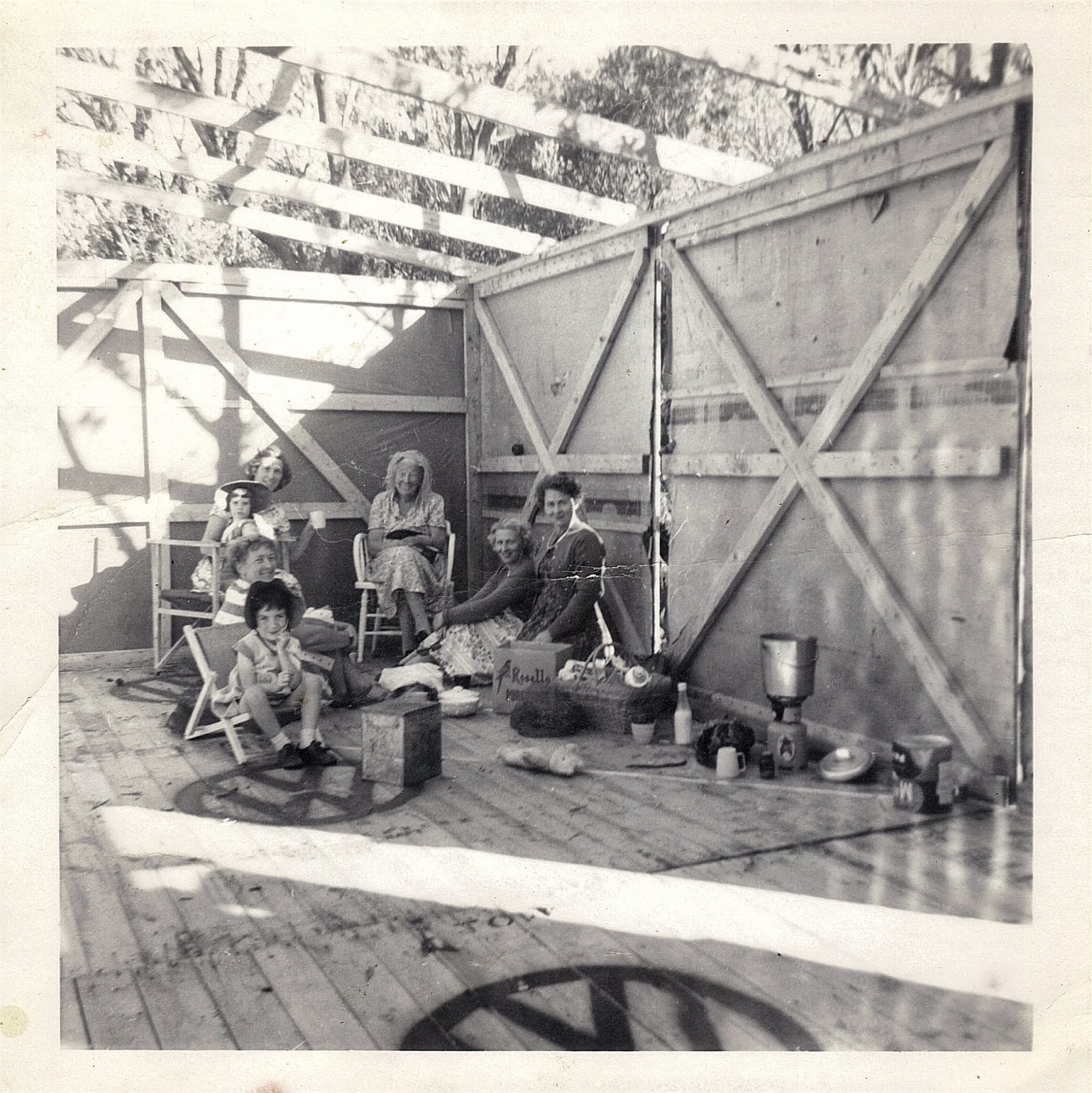
Entertaining relatives at The Shack under construction c1961-2
Me on the deck chair in front.
                                                                                                        Pilkington Family Collection ©

While the Shack was being built, our family stayed with relatives at ‘Gyndahnook’, one of the original homes.  A highlight for me was taking the big brass gong off the wall and ringing it to let Dad know down the paddock that meals were ready.
Brass dinner gong in the kitchen at Gyndahnook
                                                                                                      from Pilkington family collection ©

Although small, the Shack provided all the comforts our family of seven needed. It was a  single room construction, cleverly designed with bunks built in at either end, and shelving units dividing the sleeping areas from the living area. The eight bunks meant that one of us could have a friend come to stay.  Mum used large posters to provide a colourful display on the walls. These posters were put out by Victorian Railways or TAA (airline) to promote tourist destinations.  I seem to recall there was one for wildflowers in WA, another for skiing at Mt. Beauty, and one of the memorial cross at Mount Macedon, among others. The image below is representative of the style of posters of the times.


Victorian Railways, and E.H. Turnor Studio, Artist. Wilson's Promontory, Victoria, Australia [picture] / E.H. Turnor., 1930.

There was no electricity at Sandy Point at that time. We had gas lighting, kerosene fridge, tank water and a little pot-belly wood stove for heating when we needed it. Mum produced our meals on a small gas hotplate and griller, or outside on the barbecue she had made herself from old farm implements. Bathroom facilities were non-existent. Hot water came from the kettle. The toilet was a “long drop” dug by Dad, and enclosed in a hessian frame outside. We cleaned our teeth in a cup of water and washed when required in a plastic tub. Once a week or so, we would head to the caravan park to shower, putting sixpence into the metre for hot water. This was a communal effort – one shower for the girls and one for the boys - as Mum wanted to get the most out of her sixpences.

Our days were spent at the beach, exploring the bush, or with cousins on their farms.  Day trips and picnics to nearby locations, depending on the wind direction.  East wind - off to the Prom, where the beaches would be sheltered.  Westerly - around the coast to Walkerville which would be similarly sheltered.  My memories are of sunburn, insect bites and stubbed toes, all par for the course of an Australian bush summer.  Shoes were unheard of - we trod those gravel roads, hot beach sands and tracks through the scrub in our bare feet without complaint.  We never gave a thought to snakes.  Dad always said we didn't need to worry about snakes because they were more scared of us than we were of them.  I doubt it, but whatever, we rarely saw them even though they must have been plentiful.

At night, we stayed out until dark.  Later, we would visit with relatives, or play scrabble or card games around our little table in the Shack.  Then off to bed, drifting off to sleep to the sound of the surf or the wind through the trees, and the smell of burning mosquito coils in our noses.  Dad could pinpoint the moment the tide turned just by listening to the sound of the surf.

Cleaning out The Shack in 2016 ©kaypilk


In reality, the time we spent in The Shack was only about 7 or 8 years, before Mum & Dad built a more substantial home.  But to me as a small girl it seemed like a lifetime.  After the house was built, the Shack became the domain of my older brothers.  It then served as a storage shed, garden shed and more recently a home to multiple species of wildlife.  The Shack is still there, although now in a state of disrepair.  From time to time we have had half-hearted plans to rejuvenate it, but for the moment it remains as a reminder of the many happy memories created within its walls.


The Shack 2016  ©kaypilk


Tuesday, 14 August 2018

Doondahlin …

Amongst the treasure trove of memorabilia belonging to our extended family is the following picture, painted on a thin sheet of masonite.  It is labelled “Doondahlin” and bears the artists initials of ‘A.E.’.  An identical picture hangs on the wall at a cousin’s beach house.  These pictures would have been a reminder of home to my Irish relatives.


Doondahlin, date unknown, by 'A.E.'
 from Pilkington Family Collection


Doondahlin was one of the homes associated with my family back in Ireland, and which in present times is a ruin.  I had no idea who ‘A.E.’ might be, as the initials did not relate to any known family. 

The painting  was brought to mind again a few months ago when I received an email from a man in Ireland, seeking information about Doondahlin for a local history group.  So back to the family archives I went, to see what I could find out.


Doondahlin was the summer home of the Keane family of Beechpark, in Ennis, county Clare, Ireland.  It was built for my 3x great-uncle, the infamous Marcus Keane, probably in 1854.  An entry in his sister Charlotte’s diary in October of that year reads:  “Marcus is building a fine lodge on the cliffs at Kilbaha”.  Kilbaha is a small village by the shore of the Shannon Estuary on the Loop Head Peninsula in Clare.  These West Clare lands were the ancestral home of the Keanes (formerly O’Cahane, or Ó Catháin in Irish), and previous generations of the family had been well-respected in the area.


Doondahlin, sketched by Sarah Haughton in 1859

from Pilkington Family Collection


Marcus inherited his father’s land agency business, raising himself up the social and financial ladder by marrying the daughter of a wealthy absentee landlord, and taking on the management of his father-in-law’s extensive estates.  He became notorious during an Gorta Mór (The Great Famine) for his ruthless evictions of poor tenant farmers and the destruction of their homes. 

Doondahlin took its name from an ancient Irish hill fort, the remains of which were located on the same cliff top.  Dun Dahlin was one of four hill forts along this stretch of Loop Head Peninsula, the origins of which are based in legend.


From:
Ring-Forts in the Barony of Moyarta, Co. Clare, and Their Legends
by Thomas Johnson Westropp

Part I.—From Loop Head to Carrigaholt
(Clare Library)

Marcus Keane considered himself something of a scholar on the subject of Irish antiquities, and wrote a book published in 1867 titled “The Towers and Temples of Ancient Ireland: their origin and history discussed from a new point of view”.  Perhaps it was this interest which led him to choose this site for his ‘fine lodge’.

In his book “The Houses of Clare”, Hugh Weir describes Doondahlin as a plain L-shaped, 2 storey house, with 3-bay front, and 4-bay wing along the east side, and a single-storey 3-bay wing on the west side.  According to this newspaper advertisement, there were 3 sitting rooms, 7 bedrooms and dressingrooms, 3 servants rooms, plus kitchen, pantries, and closets. I’ve also been told that the construction of the building included a layer of turf stacked between the double brick walls to act as insulation – probably necessary protection from the Atlantic gales blowing across that exposed cliff top.

Freemans Journal 2 June 1873
from Irish newspapers at findmypast.com

The house was used as a summer residence for Marcus, his wife Louisa and their children.  After Marcus’s death in 1883, Doondahlin passed to his son Marcus junior, who owned it until it was destroyed by fire in September 1921.  Marcus the younger’s daughter Helen has written some memories of her family’s life in Clare, and she writes of vividly remembering being at Beechpark one morning when a message was brought to say Doondahlin had been burnt the previous night.  This was during the War of Independence, during which the countryside was engulfed in trouble between the Republicans and the British troops including the dreaded Black and Tans. Doondahlin was targeted presumably in retribution for the actions of Marcus Keane during the previous century.
  
Marcus Keane filed a claim for compensation to the Irish Grants Committee in 1929.  I haven’t seen his claim myself, but I am told that it outlines a previous attempt at firing Doondahlin a few months earlier, which was thwarted by the attention of the caretaker.


So, back to the picture.  While searching for information to pass on to my Irish correspondent, I did a google search for “Doondahlin” and was surprised to find the following in an on-line art catalogue – a third copy of the very same picture, together with another of the view from Doondahlin across the Shannon to Mt. Brandon in Kerry.  Both pictures were surrounded by ‘folk art frames of oystershell’.  The pair of pictures had sold for $100 just a few months previously in October 2017.


The Australian Art Sales Digest, published by John Furphy Pty. Ltd., Melbourne, Australia.

According to the catalogue, the mystery ‘A.E.’ was an Irish/Australian artist by name of Annie Eldridge. Written on the rear of this picture was ‘Mrs. Eldridge, Rosehill, Buffalo Creek, South Gippsland’.   Buffalo is in the same district in South Gippsland where my family members from Ireland settled.


After some more investigation, I came up with two possibilities.  The first was Annie Eldridge nee Farrell, an Irish woman from county Galway, who was married to a William Eldridge. The couple ran a hotel in Wodonga for many years.  This one was promising, because a Farrell family were long-standing friends of my extended family in Gippsland, and the Eldridge family of Rosehill had a son named William.  It all seemed to fit perfectly – except that the Rosehill William Eldridge was married to someone else, and this Annie didn’t fit into the Farrell family we knew.  Additionally, I could not find anything linking this couple to South Gippsland.

The second possibility was Annie Eldridge the sister of William of Rosehill.  Although this Eldridge family were of English origins, not Irish, Annie married into a family with Irish connections.  She was born in 1866, making her a contemporary of my grandfather and his brothers, and she was definitely in the right location to be acquainted with my family.  I’m still unable to connect her to Doondahlin though, so not sure what opportunity she would have had to do the painting.  

All three pictures shown here - painting, sketch and photograph - are taken from a similar vantage point on the shore of Kilbaha Bay in front of what was Kiltrellig Lodge, home of my Pilkington family.  The Pilkington sisters who lived there took in paying guests to help make ends meet.  It is not unreasonable to imagine that IF Annie Eldridge had travelled to Ireland she may have sought accommodation with the family of her friends in Australia.


The ruins of Doondahlin, 2007
© K. Vincent 2007