Showing posts with label family. Show all posts

Wednesday, 17 July 2019

1835 - Alfred Haughton's Eventful Year ...

One of the things I love about family history is finding previously unknown “cousins”, and sharing information.  You just never know what precious items might be tucked away in a shoebox at the back of a cupboard somewhere else in the world.

A couple of years ago, I connected with a third cousin. We share great-great grandparents Alfred Haughton (1808-1858) and Henrietta nee Osburne (1802 -1878). The Haughtons were Quakers, and lived at Ardreigh, near Athy in county Kildare, Ireland, where Alfred owned the mill on the River Barrow. I have written about my adventures exploring my Haughton ancestors in an earlier post.

I was able to give my new-found cousin some Haughton photographs from my family collection, and in return she shared a document recently found among some old family papers. What a treasure that turned out to be!


Alfred Haughton
photo from the Pilkington Family Collection, kindly shared by Tom Pilkington


1835 was an eventful year for the Haughton family. At the end of the year, Alfred sat down and wrote his review of the year’s events.  How amazing that we are able to read his own words now, almost 185 years later.

Review of the year 1835, by Alfred Haughton
Oh help me dear memory to count over the Lord’s love to me during the past year – & may my gratitude be daily increased & shown both by obedience to His commands & acceptance of His love.

In the Spring of the year a ruffian came into my house at night and would have killed me, but the Omnipotent enabled me to trust in Him and gave me courage & firmness, & made the other a trembling coward & no harm happened for the Lord protected me & mine

In the Summer when going to the sea with my wife and child, the horse fell under the car. I was thrown off with my boy in my arms but no harm happened for the Lord protected us. The same season I went to bathe, saw what I deemed to be deep water, dived down, came with force against a rock – but no harm happened for the Lord protected me.

In the Autumn my wife after giving birth to my daughter was on the brink of expiring but the Lord turned from the fierceness of His wrath – no harm happened for the Lord had mercy on me!!!

The same season the Lord put it into the hearts of my three brothers to make me a present of some hundreds of pounds – “for the silver and gold are His and He gives them to whomsoever He pleases” – and he tries every way to win me to His love. ----- -----

In this month Dick my first born, my darling boy was seized with fever – my beloved wife was so uneasy about him the milk she was nursing my baby daughter with became poisonous & had she given it her any longer my baby would have died – the dear infant suffered much from the want of the nourishment the Lord had so tenderly supplied. He shewed me His love by sending quickly a proper nurse for my child – my darling boy is recovering – no harm has happened in this chastening – Therefore “what shall I render to the Lord for all His benefits to me. I will take the cup of Salvation and call upon the Lord.”


*******


Alfred was the youngest son of Samuel Pierson Haughton (1748-1828) and his third wife Mary Pim (1762-1832).  The three brothers he refers to were likely his full siblings James, John and William, although he also had two older half-brothers.  All three were well established in their chosen careers by the time Alfred wrote this review. ‘Some hundreds of pounds’ would have been a considerable sum in 1835.

James Haughton (1795-1873)                 
Merchant and noted social reformer,     
active in the Temperance movement 
and anti-slavery cause. Often referred 
to as ‘Vegetable’ Haughton due to his 
vegetarian lifestyle.
By BPL - James Haughton, Public Domain,
https://commons.wikimedia.org/w/index.php?curid=9715198


John Haughton (1796-1845)                               
Miller – owned Barrow Mills in Graigue, 
Queen's county, (now county Laois).  
John Haughton’s wife was Louisa Courtauld 
Osburne, sister of Alfred’s wife Henrietta.

Silhouette picture of John Haughton. 
Kindly shared by Anita Hansen, Iowa, USA


William Haughton (1799-1877) 
Partner with his brother James in 
Haughton Merchants & Flour Factors 
based in Dublin.  Also Chairman of 
Great Southern & Western Railway 
Company of Ireland.

William Haughton. Picture shared on ancestry.com by Theo Haughton 2008


The baby daughter born in Autumn was my great grandmother Mary Haughton, who I have written about in Ordinary Women.  Her birthdate was 29th August, according to her baptism record.  Her brother, the little boy sick with fever, was named John, so perhaps Dick was a nickname used within the family.  John, Mary and their younger brother Henry were all baptised together in Painestown, Carlow on 7 March 1838.  


my great grandmother, Mary Haughton
photo from the Pilkington Family Collection


*******


2 May 1835 - Belfast Commercial Chronicle - Belfast, Antrim, Northern Ireland 
From Irish Newspapers at findmypast.com


It was also an eventful year for the ‘ruffian’ identified as Henry Rainsford.  As reported in the newspapers, Henry was charged and convicted on 9th July 1835 at the Kildare Assizes.  According to the harsh justice of the times he was sentenced to death by hanging, but records show that was later commuted to transportation for life. 


16 July 1835 - Mayo Constitution - Castlebar, Mayo, Republic of Ireland
From Irish newspapers at Findmypast.com


                                                                                                  14 August 1835 - Athlone Sentinel - Athlone, Westmeath, Republic of Ireland 
                                           From Irish Newspapers at Findmypast.com


Henry Rainsford (sometimes recorded as Ransford) was transported to New South Wales on the ship Hive, departing Cove on 24th August with 250 male convicts on board.  At least poor Henry didn’t have to spend months or years in prison before departing.  He left behind his wife Bridget and two children – 4 year old Elizabeth and 1 year old John. I wonder how Bridget fared with 2 small children to bring up on her own?

Henry’s arrival in NSW was a dramatic one, with the Hive running aground in the sand near Jervis Bay south of Sydney during the night of the 9th December.  After making it to shore with the loss of only one crew member, the remaining travelers had to await rescue from Sydney, finally reaching their destination on 24th December.


ANOTHER SHIPWRECK. (1835, December 14). The Sydney Herald (NSW : 1831 - 1842), p. 3. 
Retrieved July 6, 2019, from http://nla.gov.au/nla.news-article28654515


The story of the convicts on board Hive has been told in the book “The Luck of the Irish” by Babette Smith (Allen & Unwin 2014)

From the convict records, Henry was 36 years old, married with 2 children.  He was Roman Catholic and could read and write.  His former employment was as a boatman and labourer.  His convict record appears unremarkable, achieving a ticket-of-leave on 15th April 1844, the conditions of which confined him to the district of Penrith.  This was amended on 8th June to allow him to travel between Liverpool Plains and Penrith in the service of his employer Mr. John Single.  Henry was granted his conditional pardon on 9th June 1849, after which I have found no further record of him.  He may have moved to another colony, or even changed his name to conceal his convict background.

Tuesday, 30 April 2019

A Picnic When Cars Were Few ... a Trove Tuesday post.

If the internet had been around 50 or 60 years ago, I’m sure my mother would have been a blogger.  She loved to write, and for a few years when we children were small, she wrote a weekly column in a national church newspaper chronicling our family life.  I intend to share extracts of those in future posts. 

In 1961, mum had an article published in the Literary Supplement which came with The Age newspaper every Saturday.  She received a cheque in the amount of £6/6/- as payment, a sum which would have been a welcome addition to the household income.  Here is her story, a recollection of her own childhood days in the 1920s-30s.


A PICNIC WHEN CARS WERE FEW

by Dorothy Pilkington

It is generally accepted as the prerogative of double chins, walking sticks and snowy hair to reflect upon bygone days.  The excusable exception is surely when one’s eight-year-old pride and joy naively inquires, “Mummy, did you live in the olden days?”  “What olden days?” I exploded, as a plate I was wiping crashed to the floor in profound sympathy.  Yes, what indeed?

Much later, when the child had long since forgotten the query, it remained with me, an impression searing into my consciousness the realisation that there is now another generation which has the audacity to relegate a 38-year-old to “the olden days” in precisely the same manner in which we regarded our parents in days of yore!

Never will my family experience the thrill of a large family picnic, held twice yearly (Boxing Day and Easter Monday, rain or shine), in horse-drawn furniture vans rattling along the Point Nepean Road to the mecca of all picnic parties of the era, at the Mordialloc Creek.

There were aunts, uncles, cousins, grandparents and in-laws of all degrees; everyone highly attuned in eager anticipation of the day ahead.  The flappers pioneering the “new look” of the Charleston period, giggling in innocent delight at their daring.  The mothers dressed sombrely in blouse and long skirts, with parasols and big, floppy hats with fly nets attached; the older men with their droopy moustaches and beards, wearing hairy tweeds, heavily steeped in a combined aroma of pipe tobacco and beer.

For the female members of the family the day was the culmination of many weeks’ culinary preparations.  The delightful unpacking of lunch baskets, full of delectable mysteries, never failed to make our child eyes goggle, and set our salivary mechanism working overtime.

We children were critically appraised by the various aunts, while our rate of growth since the last occasion appeared to provide them with much comparative material to aid their wholesome exclamations: “My, hasn’t she grown. She’s getting so like you, dear!”

For the afternoon activities, races of all descriptions were organised by the younger men, with the elder sitting on the sidelines contentedly drawing on their pipes and dozing in the sunshine. Huge quantities of boiled lollies were consumed by the youngsters, vying with each other for the most colorful patterns.

Sunset was the curfew for our departure, tired, sticky, full beyond measure with a sense of happiness complete; snuggling upon the laps of grown-ups in sheer exhaustion; the lusty singing of nostalgic airs to the accompaniment of a piano accordion, wafting us to sleep with the gentle clip-clop, clip-clop of the faithful horses’ shod hooves.

Curses upon the motor car, even then finding favour; spewing oil and grease upon the road until the fateful night when one of the horses slipped …

As I speed along the Nepean Highway today in all the splendour of gleaming chrome and superbly sprung luxury, keeping apace with the modern tempo of living, I hark back in wonder to those leisured days.

Would that my children could experience but one facet of the life we once glimpsed – yet so briefly.

published in The Age, 22nd July 1961.


Mordialloc appears to have been a popular destination for a day at the seaside, being easily accessible by train, or by the Point Nepean Road (now Nepean Highway).  Not only family gatherings, but Sunday School picnics, annual trade and company outings were popular, regularly reported in the newspapers of the day.

"WHERE TO SPEND A HOLIDAY." The Argus (Melbourne, Vic. : 1848 - 1957) 
23 December 1924: 7. Web. 28 Apr 2019 <http://nla.gov.au/nla.news-article2090237>. 


Mordialloc was also noted for its annual carnival held over the summer holiday period from 1924 through to 1939.  It featured parades, amusements, side-shows, sporting events and other activities and was a popular holiday attraction.  The history of the Mordialloc Carnival has been written about here in the Kingston Local History website.


"HOLIDAY RESORTS." The Argus (Melbourne, Vic. : 1848 - 1957) 
10 January 1927: 15. Web. 28 Apr 2019 <http://nla.gov.au/nla.news-article3831327>. 


Mum’s mother, my grandmother, was one of five daughters of John Grant and Elizabeth nee Duffy.  John’s own grandfather, also John Grant, had settled in Brighton in the 1840’s, and ran a successful carrier business.  The extended Grant family were well established in the district, with four generations all raising families there.  The younger John, and his brother William, both had carrier businesses.  It was likely company vans which ferried the families to their bi-annual picnics.  I have tried to find a newspaper reference to the accident involving the horse slipping on the greasy road, but without a specific date range it has proved unsuccessful.

Postcard of Mordialloc Creek 1919 
http://handle.slv.vic.gov.au/10381/367432

Monday, 25 February 2019

The Shack …

Nearing the end of February, and the official end of summer – although hopefully we will still have several more weeks of summery weather.  This has prompted me to think back to summers past, and childhood memories of “The Shack” which was the base for our summer holidays at Sandy Point.


Sandy Point beach 2018 ©kaypilk 

My father grew up at Sandy Point, on the shores of Waratah Bay in South Gippsland, where his father with two brothers and their cousin, had settled in the 1890’s after emigrating from Ireland.  The four families had grown up together and remained close.  My father’s path in life took him away from the land, and his family property had been sold after the death of my grandfather.  Several of his cousins remained on their family farms, and others returned regularly for holiday visits, so it was natural for my parents to keep the connection.

One of my earliest memories, when I would have been about 3 or 4 years old, is of crawling through tea-tree scrub with Mum & Dad as they checked out the advantages and disadvantages of various blocks in the new Playground Estate, recently developed on the dunes separating the beach from the farmland behind.  Eventually, they chose a block for the view it provided over the farmland, with Shallow Inlet and the South Gippsland hills beyond.  They named this property "Kiltrellig" in memory of the old Pilkington family summer home in the west of county Clare, Ireland.

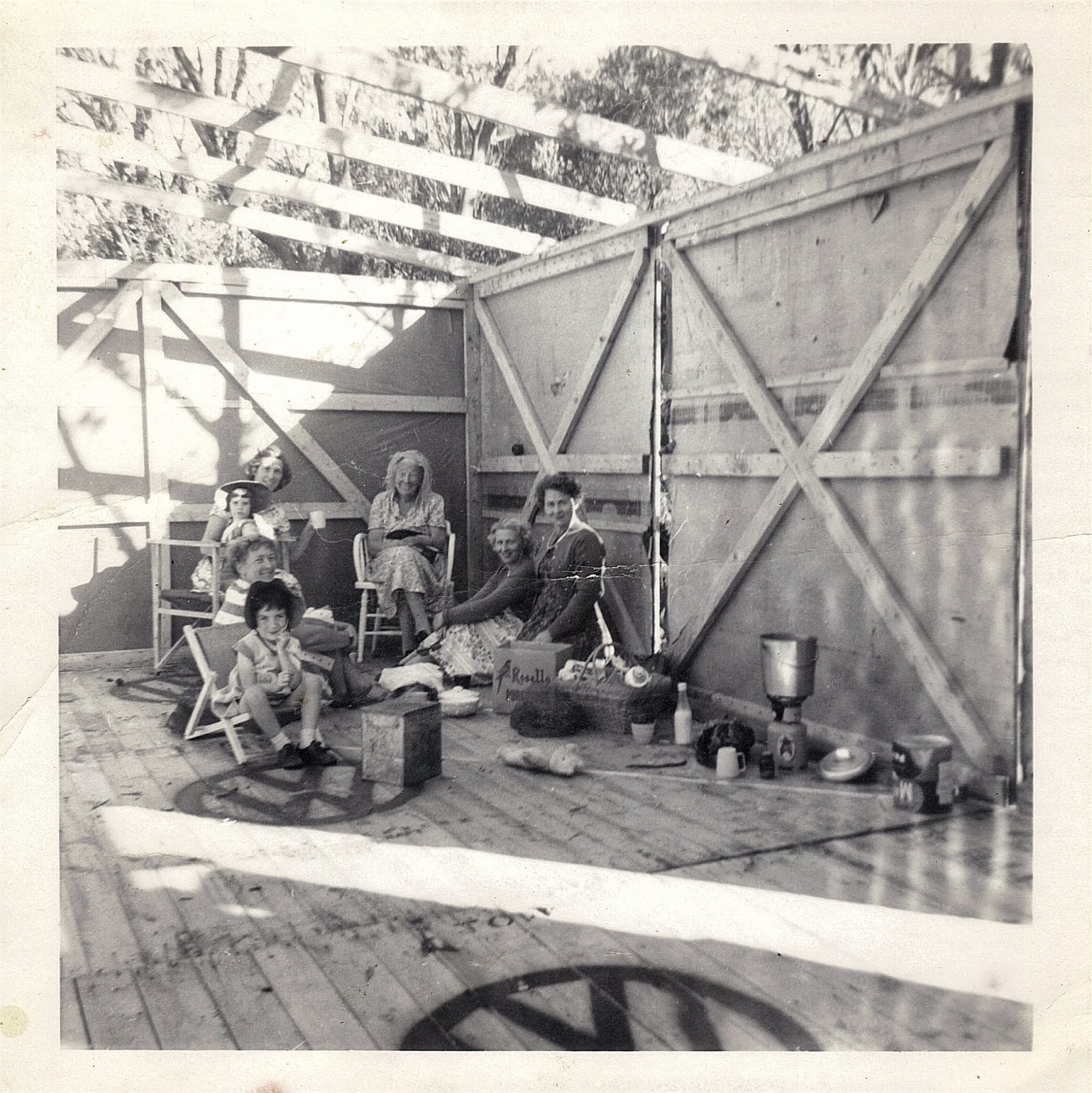
Then came construction of "The Shack", built by Dad out of Volkswagen packing cases.  This would have been a cheap source of timber to use for the floor and exterior cladding.  The interior of the frame was unlined, but covered with bitumen-impregnanted brown paper sheeting to cover any gaps and reduce damp.  The Shack was built on what Mum referred to as "the leafy lane', which had been the old track connecting the original family homes before the roads were made.

Entertaining relatives at The Shack under construction c1961-2
Me on the deck chair in front.
                                                                                                        Pilkington Family Collection ©

While the Shack was being built, our family stayed with relatives at ‘Gyndahnook’, one of the original homes.  A highlight for me was taking the big brass gong off the wall and ringing it to let Dad know down the paddock that meals were ready.
Brass dinner gong in the kitchen at Gyndahnook
                                                                                                      from Pilkington family collection ©

Although small, the Shack provided all the comforts our family of seven needed. It was a  single room construction, cleverly designed with bunks built in at either end, and shelving units dividing the sleeping areas from the living area. The eight bunks meant that one of us could have a friend come to stay.  Mum used large posters to provide a colourful display on the walls. These posters were put out by Victorian Railways or TAA (airline) to promote tourist destinations.  I seem to recall there was one for wildflowers in WA, another for skiing at Mt. Beauty, and one of the memorial cross at Mount Macedon, among others. The image below is representative of the style of posters of the times.


Victorian Railways, and E.H. Turnor Studio, Artist. Wilson's Promontory, Victoria, Australia [picture] / E.H. Turnor., 1930.

There was no electricity at Sandy Point at that time. We had gas lighting, kerosene fridge, tank water and a little pot-belly wood stove for heating when we needed it. Mum produced our meals on a small gas hotplate and griller, or outside on the barbecue she had made herself from old farm implements. Bathroom facilities were non-existent. Hot water came from the kettle. The toilet was a “long drop” dug by Dad, and enclosed in a hessian frame outside. We cleaned our teeth in a cup of water and washed when required in a plastic tub. Once a week or so, we would head to the caravan park to shower, putting sixpence into the metre for hot water. This was a communal effort – one shower for the girls and one for the boys - as Mum wanted to get the most out of her sixpences.

Our days were spent at the beach, exploring the bush, or with cousins on their farms.  Day trips and picnics to nearby locations, depending on the wind direction.  East wind - off to the Prom, where the beaches would be sheltered.  Westerly - around the coast to Walkerville which would be similarly sheltered.  My memories are of sunburn, insect bites and stubbed toes, all par for the course of an Australian bush summer.  Shoes were unheard of - we trod those gravel roads, hot beach sands and tracks through the scrub in our bare feet without complaint.  We never gave a thought to snakes.  Dad always said we didn't need to worry about snakes because they were more scared of us than we were of them.  I doubt it, but whatever, we rarely saw them even though they must have been plentiful.

At night, we stayed out until dark.  Later, we would visit with relatives, or play scrabble or card games around our little table in the Shack.  Then off to bed, drifting off to sleep to the sound of the surf or the wind through the trees, and the smell of burning mosquito coils in our noses.  Dad could pinpoint the moment the tide turned just by listening to the sound of the surf.

Cleaning out The Shack in 2016 ©kaypilk


In reality, the time we spent in The Shack was only about 7 or 8 years, before Mum & Dad built a more substantial home.  But to me as a small girl it seemed like a lifetime.  After the house was built, the Shack became the domain of my older brothers.  It then served as a storage shed, garden shed and more recently a home to multiple species of wildlife.  The Shack is still there, although now in a state of disrepair.  From time to time we have had half-hearted plans to rejuvenate it, but for the moment it remains as a reminder of the many happy memories created within its walls.


The Shack 2016  ©kaypilk


Wednesday, 25 April 2018

In the Service of his Country…

My Anzac Day tribute this year is in honour of my husband's grandfather.  The following piece was written for "Families at War", a unit in the University of Tasmania's Diploma of Family History.


                                               JAMES JOSHUA PERRY
                                   1889 - 1934


The physical and psychological injuries sustained by so many Australian men returned from World War 1 (WW1) changed the course of not only their own lives, but those of their families too.  His children grew up believing that James Joshua Perry died as a result of being gassed in the trenches of France.  In reality, 44-year-old Jim died from aortitis resulting from syphilis contracted while convalescing in England after being wounded.  Jim was one of an estimated 60,000 Australian troops treated for venereal disease during WW1.
 
The fourth child of James and Catherine Perry, Jim was born in 1889 near Jugiong in rural New South Wales.  He left home as a youth and spent several years as a sailor on trading vessels. Jim enlisted for service in Melbourne on 6th October 1914.  There is no record of what motivated him to enlist, but he was subsequently posted as a  deserter from the steamship Marere on 16th October. The Marere had spent the previous month in Sydney being converted to a troop ship, and was in Melbourne en route to Albany, Western Australia, where she joined the first convoy of Australian Imperial Forces.  
 
After enlisting, Jim would have spent a few weeks at the Broadmeadows Training Camp north of Melbourne. Initial training consisted of instruction in the use and care of weapons, entrenching tools, and instilling military discipline into the recruits.  Jim was assigned the rank of Driver in the 2nd Field Artillery Brigade Reinforcements, a role for which his family background of breeding horses would have suited him well.  In WW1, Driver was an equivalent rank to Private and was responsible for a wagon and team of horses used to transport weapons, ammunition and supplies to the Front, and transport the wounded back. Drivers were responsible for the care of the horses in their team.  Although not directly involved in fighting, they were often a target for enemy fire because of the work they performed.
 
Jim embarked from Port Melbourne on 22nd December 1914, on board HMAT A30 Borda.  The ship then sailed from Albany, Western Australia in convoy with 16 other vessels on 31st December 1914 as the Second Detachment of the Australian and New Zealand Imperial Expeditionary Forces.  On arrival in Egypt, Jim was transferred to the 2nd Field Company Divisional Engineers.  It is uncertain what part he played in the Gallipoli campaign, as his record does not reflect this.  Field diaries reveal the 2nd Field Company didn’t land at Gallipoli until 7th November.  Jim’s record shows that after the Gallipoli evacuation in December 1915, he was transferred to Maadi, the Cairo camp of the 1st Australian Light Horse Brigade, so it is possible he was with them. 

 
Jim re-joined the 2nd Field Company Engineers at Tel El Kabir at the end of December 1915.  This was a training camp set up in the Egyptian desert for recuperation and re-organisation of troops, with intensive training in preparation for transfer to the Western Front.  Three months later he proceeded to Alexandria, embarking on S.S. Simla, to arrive at Marseilles on 30th March.  
 
From Marseilles, the unit had a grueling three day train journey to the village of Steenbecque in Northern France, arriving at 0200 on 2nd April only to find they then had a twenty mile march to their camp.  Although tedious, several diarists commented on the contrasting beauty of the landscape compared with Egypt.
 
Throughout April, the men moved north to the battlefields. Jim was re-mustered as a Sapper, and the remainder of 1916 was spent working to reinforce trenches, create new dug-outs for gun crews and road-building works.   The appalling weather conditions of the 1916-17 winter hampered progress as the men faced freezing temperatures and constant mud & snow.

 
On 27th January Jim took a gunshot wound to his left thigh. He was treated at the 45th Casualty Clearing Station at Edgehill (Dernancourt), before being transported via Rouen to 2nd Birmingham War Hospital, England on 1st February 1917. 
                
                                             Figure 1: Description of wound

‘Gas’ was the dreaded gas gangrene, caused by the bacteria Clostridium Welchii, which thrived in deep wounds and often led to amputation.  Prevention included leaving the wounds open to allow oxygen circulation and minimise the infection.  This delayed healing time compared with suturing wounds closed.  Jim spent two months at Birmingham, where he probably met his sister Eleanor who was stationed there with the Australian Army Nursing Service.  
                                                      
 After six weeks convalescing at 3rd Australian Auxiliary Hospital, Dartford, Jim had 3 weeks furlough, following which he spent time at various command depots and training camps in preparation for returning to the Front.  However on 25th July, Jim was admitted to hospital diagnosed with venereal disease. He was treated for both gonorrhoea and syphilis at 1st Australian Dermatological Hospital at Bulford for 2 periods of 20 days and 22 days during the months of July to September.  Treatment was complicated, painful and not guaranteed to be effective.  In Jim’s case he was deemed to be cured, as evidenced by a negative screening test obtained in March 1918. 
 
The next eight months were spent in training camps recovering and building up strength before returning to France in May 1918, to the Australian General Base Depot at Le Havre. There is no record of where Jim went from there, or if he saw any active service again. As a 1914 enlister, Jim qualified for six months ‘Special 1914 Leave’, and left for Australia on 13th October 1918.  When the Armistice was signed on 11th November, he would have been at sea.
 
Back in Australia, Jim returned to his former life on the trading ships, until his brother’s wife introduced him to her cousin Mary Forristal. They married on 10th February 1923, and Jim took employment with the Tramways.  The following year, they became parents to twin daughters Theresa and Patricia, followed in 1930 by son Jack.

In September 1933, Jim presented to his doctor with pain in his left leg, shortness of breath, and swelling of his face.  He was referred to the Alfred Hospital where his heart condition was diagnosed. His application to the Repatriation Commission for a pension in November 1933, when he could no longer work, was rejected on the grounds that his condition was not due to war service.   Two appeals were also rejected.  It was not until Mary Perry notified the Repatriation Commission of her husband’s death, and requested a pension for herself that the Board relented and granted approval in September 1934.
 

James Perry died in the Alfred Hospital on 12 July 1934.  The War pension enabled Mary to bring up their young family, and provide them with a good education.  Jim was as much a victim of his war service as anyone else who served.  He was one of an estimated 38 men and 1 woman from Jugiong who enlisted, but surprisingly there was no war memorial raised in Jugiong after WW1.  In 2014 a memorial was erected to mark the 100-year anniversary, but although his brother John is listed, Jim and his sister Eleanor are not mentioned.  His many grandchildren and great grandchildren are a testament to his sacrifice and service.

Jim & Mary Perry with Theresa & Patricia c1928


  © Katrina Vincent 2018. Written for Families at War unit, University of Tasmania. A fully referenced PDF of this work is available on request.

Wednesday, 24 December 2014

Christmas 1918

1918 marked 20 years since Fred and Dan Pilkington had ridden down to this southern-most part of the country to take up the old Sandy Point run.  The intervening years had seen them joined firstly by their cousin Charlie Griffin, and later by another brother, my grandfather Charlie Pilkington.  The four men had all married, and were raising their young families.  On Christmas Day in 1918, there would have been 12 children, ranging from my father Haughton, the eldest at 10 years, down to baby Keane, just a few months old.

Sandy Point at that time was a small farming settlement, still quite isolated from the rest of the world.  The little community was self-sufficient, relying on each other not only for assistance with the day to day work of the farms, but also for company and entertainment. 

The Commonwealth Tree, so-named for the six main branches, representing the six states making up the new Commonwealth of Australia, was a big old tree, and a gathering place for the families to meet.  The tree is long gone, and holiday homes now occupy the area where it once spread its branches.  What species is was has been forgotten with the passage of time - none of those who celebrated Christmas under its canopy in 1918 remain to enlighten us.  It was possibly a large banksia (Banksia Integrifolia, or Coast Banksia), that being the dominant variety growing between the dunes and the farming flats.  Or a Manna Gum, providing habitat for the koala.  But it could just have easily been a She-oak, or even an introduced Cyprus.

Christmas Day would have been a rare day off from the duties and chores of farming life.  A time to get together and celebrate, enjoying the company of the extended family and the freedom of the bush.  While the children played, and the women busied themselves with the Christmas picnic fare, I imagine the men sat there with their pipes and discussed the state of the world.  World War 1, which had raged for the previous four years, was finally over.  Events in their native Ireland were still unsettled, following the general election of that year, which saw Sinn Fein claim victory.  This was a key point in the Irish struggle for independence, and I'm sure would have been of great interest to these four expatriot Irishmen.
 
Great Uncle Fred immortalised this Christmas Day for us in his poem about the Commonwealth Tree.  It evokes vivid images of the occasion and provides a glimpse of the simpler life led by our forebears.  What they didn't grow or make for themselves, they just didn't have.  And yet, Fred's poem tells us they still had Christmas with all the trimmings - decorated the old tree, appearance by Santa, and presents all round for the children.


THE COMMONWEALTH TREE

Christmas 1918

At the Commonwealth Tree, the grand old tree.

All were happy as happy could be.

For it, you know, was Christmas Day,

In our own dear glade, by the deep blue bay.

Tea and cake there was galore

Sandwiches, and lashings more.

Each household had its Christmas joint

God bless the wives of Sandy Point.


To the Commonwealth Tree, the grand old tree,

Came Rose and Dan to join the spree.

“She-oaks” too, and “Ennisvale”

With “Gyndahnook” had struck the trail.

Within the glade the air was balm,

Beyond, the deep was glassy calm

So all the clan had gathered round,

And mustered at the picnic ground.


At the Commonwealth Tree, the grand old tree,

The kiddies were happy as kiddies should be.

In feasting and fun there was never a pause

Til popped on the scene was old Santa Claus.

Then all the children gathered round

A real tree, right in the ground,

And Santa radiant by its side

As groom before his blushing bride.

From trunk to top-most limb was spread

With gorgeous toys and streamers red.

And Nance and Maize, with nut brown hair

With Ede and little Vidie are there.

Haughton, Ib and curly Peggy

Richard Nash and dimpled Teddy,

Tom and Jacky, sturdy boys,

Eager all to grasp their toys.

Honest eyes of brown and blue,

Flashing glances, straight and true,

Coyly seen beneath their lashes,

Waists so gaily swathed in sashes,

Ribboned hair and stockinged feet,

buckled shoes and tunic neat.

Happy children, fair and free,

As winds that rocked their Christmas tree.


At the Commonwealth Tree, the grand old tree,

Many, many happy gatherings be.

Should boys and girls in virtue grow,

Will good old Santa come and go.

Seek virtue, not the world’s renown

And forward press to win the Crown,

For time, all earthly ties will sever,

This Crown with thee will last for ever.

God Save the King and Santa Claus

Was sung, for worthy was the cause

Responsive to the clamour made

The echoes rang then through the glade.

Then a jackass overhead

In a joyous outburst said

Bushland babies all goodnight

Sweet be your sleep til morning light.

 
F. W. Pilkington

Sandy Point

Christmas 1918


So, as I finish my preparations for Christmas 2014, and look forward to spending another summer holiday at Sandy Point, with family immediate and extended, I look back and think both how much life has changed, and how much it hasn't.  No matter how busy our lives get, or how far away we are, the joy of Christmas celebrations and the connection with family remain constant.